Observe.AI vs Proponent: Which One Fits Your Call Center?
Observe.AI and Proponent both check every call with AI. Observe.AI is a broad CX platform of AI agents, live assist and QA; Proponent checks each call against your own SOP and writes results into your systems. Here is how to choose.
 Prashant MohiteCo-founder & CEO8 min read

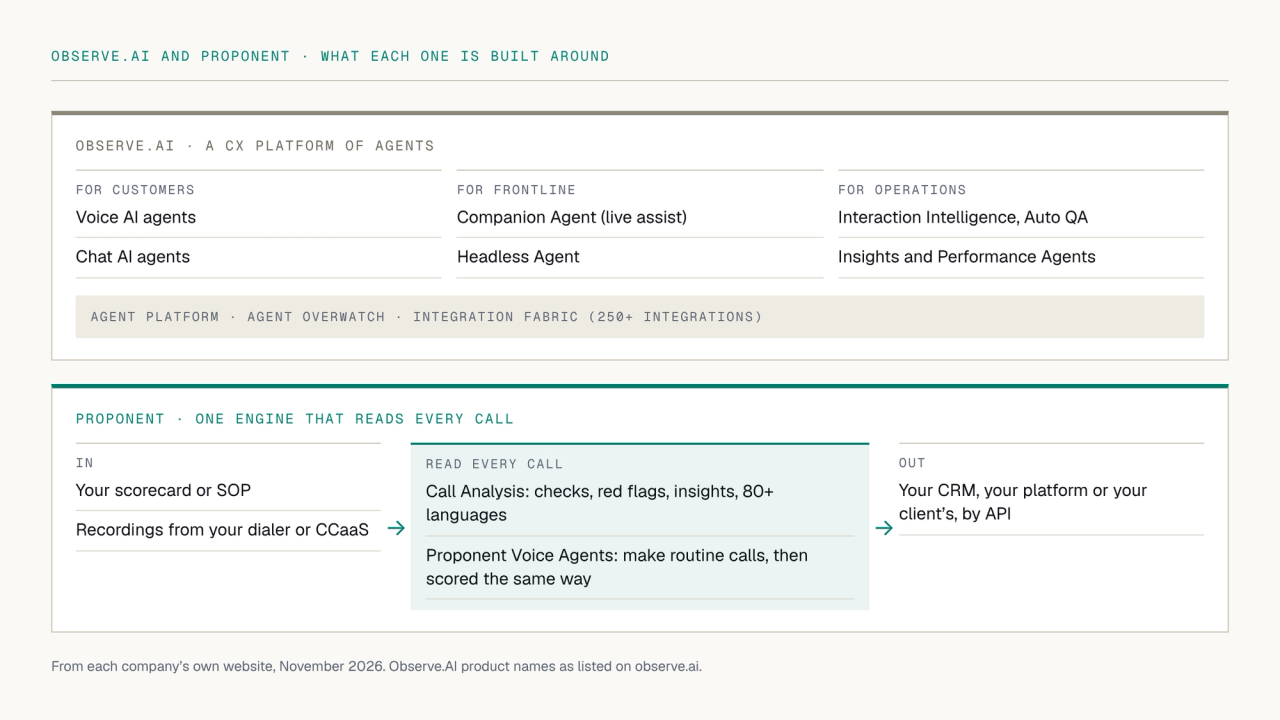
Observe.AI and Proponent both use AI to check every call in a contact center instead of a small manual sample. Observe.AI is a broad customer experience platform built around AI agents: voice and chat agents for customers, live assist for human agents, and QA and coaching for operations. Proponent is narrower. It reads every call against your own SOP or client scorecard, writes the result into the system you already run, and makes routine calls with Proponent Voice Agents.
So the choice usually comes down to one question: do you want one platform that runs most of your customer experience stack, or a QA and call analysis layer that fits into the stack you already have? This comparison covers what each one does, where each is stronger and what to ask in a demo. Observe.AI's details come from its own website as of November 2026; confirm them with Observe.AI before you decide.
The short answer
Choose Observe.AI if you run a large enterprise contact center across voice, chat and email, and you want live agent assist, AI agents that resolve customer conversations, QA and coaching from one vendor, backed by a long list of security certifications and integrations.
Choose Proponent if your main problem is what happens to each call after it ends: checking it against your own SOP or your client's scorecard, in 80+ languages including mixed-language calls, with the line from the call behind every check, and pushing the result into your CRM or your client's platform by API. Proponent also suits teams that want routine outbound calls, such as interviews, surveys and follow-ups, made by voice agents and scored the same way.
Side by side
| Observe.AI (per its website, Nov 2026) | Proponent | |
|---|---|---|
| Main focus | Agentic AI platform for customer experience: AI agents, live assist, QA and coaching | Every call checked against your own SOP, with results written into your systems |
| QA coverage | Auto QA on every call and chat against your rubric | Every call checked against your own scorecard |
| Evidence for scores | Transcript moments behind every score | The line in the call behind every check |
| QA workflows | Manual QA for disputes and appeals; AI and human score calibration | Checks and red flags on every call, each with the line behind it |
| Real-time agent assist | Yes, Companion Agent | No; Proponent works after the call |
| AI agents | Voice AI and Chat AI agents for customer conversations | Proponent Voice Agents for routine calls that follow a guide |
| Channels | Voice, chat and email | Calls |
| Languages | 25+ languages for its AI agents | 80+ languages, including mixed-language calls |
| Integrations | 250+ integrations, open APIs and MCP | Contact center platforms, dialers, cloud telephony and CRMs; results by API |
| Security | States SOC 2, HIPAA, ISO 27001, ISO 42001 and PCI Level 1 certification | AWS hosting, encryption, self-hosting option; SOC 2 Type II audit underway |
| Pricing | Custom; no public self-serve tier | Published starting prices per minute; quoted from call volume |
What Observe.AI does
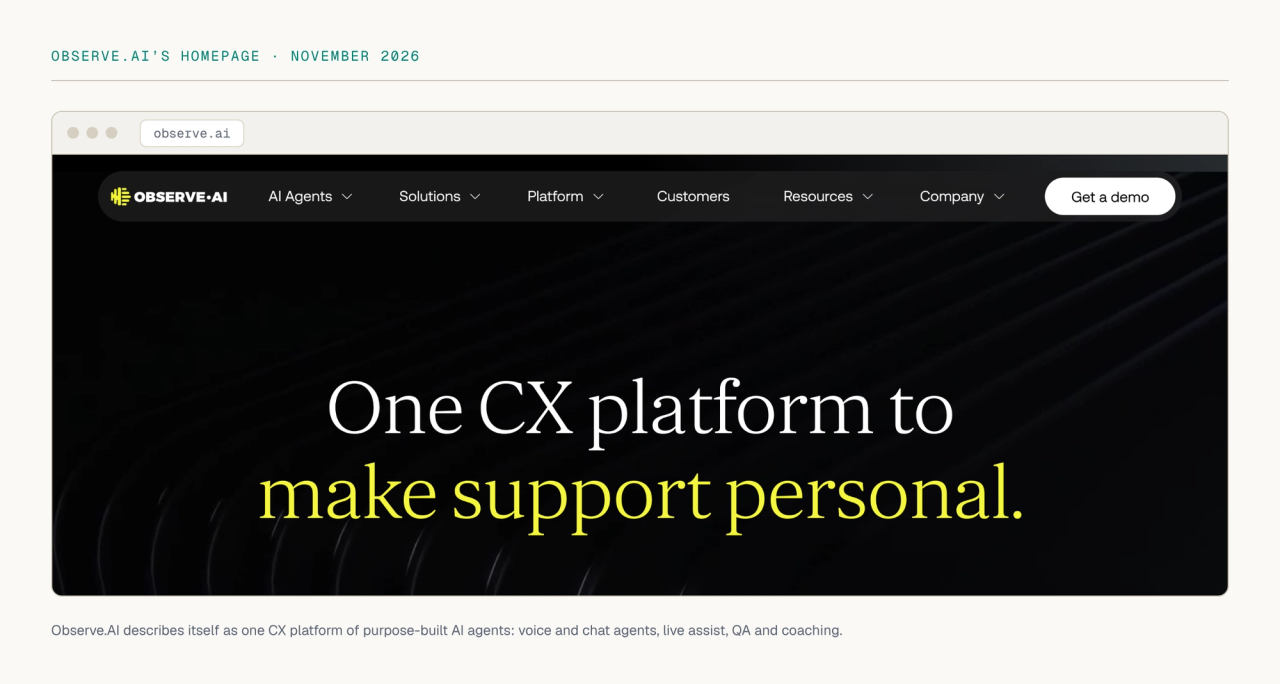
Observe.AI describes itself as "the agentic AI platform for customer experience." Its product line has three groups of agents, as listed on its site in November 2026:
- For customers: Voice AI and Chat AI agents that handle customer conversations on their own.
- For frontline staff: the Companion Agent for real-time assist during live calls, and a Headless Agent that pushes guidance into existing agent desktops and CRMs.
- For operations: Interaction Intelligence with Auto QA, plus Insights and Performance Agents for analysis and coaching.
Under these sit an agent platform, Agent Overwatch for monitoring conversations, and an Integration Fabric that Observe.AI says covers 250+ integrations, open APIs and MCP support.
On QA, Observe.AI's Interaction Intelligence page says Auto QA "evaluates every call and chat against your rubric, with the exact transcript moments behind every score." It also lists manual QA workflows "for disputes, appeals and high-stakes calls" and calibration between AI and human scores. The same page frames the problem as manual review that reaches about "2% of calls."
What Proponent does
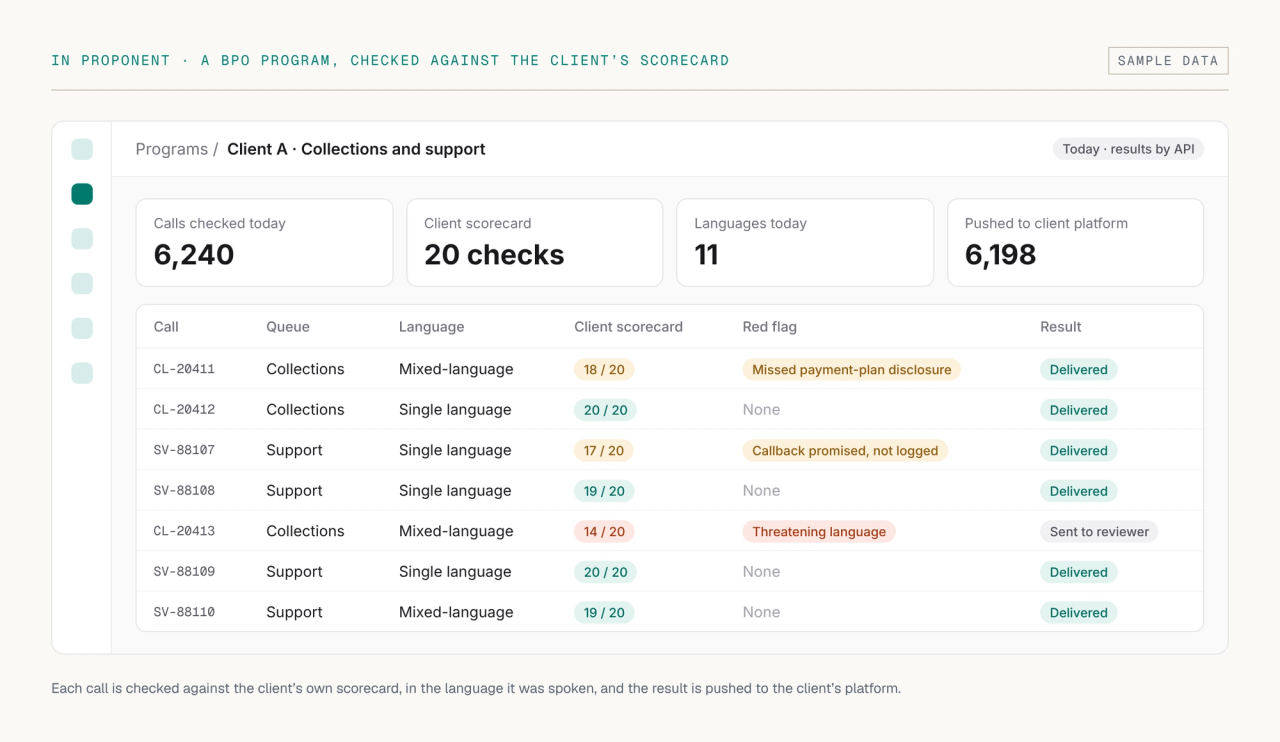
Proponent runs on one engine that reads every call. Call Analysis starts from your QA scorecard, SOP or interview guide, takes recordings from the dialer, recorder or CCaaS platform you already use, and reads each call in full. For every call it marks each check on your scorecard, raises red flags, extracts the fields you define and links each result to the line in the call that decided it.
The output goes where your team or your client already works. Proponent integrates with contact center platforms such as Genesys Cloud, NICE CXone, Five9 and Amazon Connect, with dialers and cloud telephony used widely by BPOs, and with CRMs such as Salesforce and HubSpot. Results are pushed into your own platform or your client's, call by call.
Proponent Voice Agents make the calls that follow a script or guide: exit and engagement interviews, surveys and follow-ups. Each call a voice agent makes is scored against the same guide as a call made by your people.
One example: AceNgage, which runs exit, stay and new-hire interviews for enterprise HR teams, processes 15,000 calls a month through Proponent, at an average of 25 minutes a call. Proponent extracts 40 insights and runs 20 QA checks on each call, and the output goes straight into AceNgage's own platform by API.
Where Observe.AI is stronger
A fair comparison starts with what the other product does better.
Live help on the call. Observe.AI's Companion Agent guides agents while they talk. Proponent does not offer real-time assist; it works after the call. If your biggest cost is new agents struggling mid-call, live assist is the more direct fix.
AI agents that resolve customer conversations. Observe.AI's Voice AI and Chat AI agents are built to handle inbound customer service conversations across voice and digital channels. Proponent Voice Agents focus on routine calls that follow a guide, and Proponent does not handle chat.
More channels. Observe.AI covers voice, chat and email, and stitches them into one case. Proponent is built for calls.
Enterprise compliance paperwork. Observe.AI's information page states SOC 2, HIPAA, ISO 27001, ISO 42001 and PCI Level 1 certification. Proponent is hosted on AWS with encryption in transit and at rest, offers self-hosting, and its SOC 2 Type II audit is underway. If a certificate is a hard requirement today, check the current status with both vendors.
Mature QA workflows at scale. Observe.AI lists disputes, appeals, calibration and audit trails, and publishes large enterprise references on its homepage. Large QA teams with formal calibration programs get a lot of process built in.
Where Proponent fits better
Your SOP, not a generic rubric. Proponent starts from the document your team already uses, whether that is a QA scorecard, an interview guide or a client's compliance checklist. Beyond pass and fail checks, it extracts the specific fields you define, such as reasons, risk status or next steps. If you need a starting point, our call QA scorecard template has ready-made examples.
Many languages on the same floor. Proponent analyzes calls in 80+ languages, including mixed-language calls where a caller switches languages mid-sentence. Observe.AI's voice AI page lists 25+ languages for its AI agents. If your agents handle many languages, test both on your own recordings.
BPOs that report to clients. Outsourced centers often have to deliver QA results into a client's system, against the client's scorecard. Proponent pushes results by API, call by call, so the client sees the same evidence your QA team sees.
“This is more of a tool where it can be implemented in BPOs where they have to monitor the call, maintain the call quality, maintain the quality parameters. The audit does not need to be done by someone manually.” (Founder of a cloud telephony company that serves BPOs, on a Proponent demo call)
Published, usage-based pricing. Observe.AI says its pricing is custom and that there is no public self-serve tier. Proponent's pricing page lists starting prices: from $0.03 per minute analyzed for call centers and from $0.12 per minute of calls for Proponent Voice Agents. Quotes are scoped from your call volume, not seats.
Routine outbound calls. If a person on your team dials every exit interview, survey or follow-up and then writes it up, Proponent Voice Agents can make those calls and write the record, while every call is still checked against your guide.
How to decide
Start with the problem that costs you most today.
- Agents need help during the call. Look at Observe.AI's live assist first. Proponent does not do this.
- Most calls are never reviewed. Both check every call. Compare them on your own scorecard and your own recordings, including your hardest calls.
- Results must land in another system. If QA results have to go into your CRM or a client's platform, test the write-back in the demo, not just the dashboard.
- Your calls cover many languages. Send recordings in every language you handle, including mixed-language calls, and compare the transcripts and scores line by line.
- You need one vendor for chat, email and voice AI agents. Observe.AI covers more of that ground.
To size the gap first, the free call QA calculator shows how many of your calls get reviewed today and what full coverage would mean for your team.
Questions to ask in a demo
- Can you score a batch of our own recordings against our current scorecard, without rewriting it into your template?
- For a failed check, can I see the exact line in the call that caused it?
- How do you handle calls that switch languages mid-call?
- Where do results go, and can you push them into our CRM or our client's platform by API?
- What does pricing depend on: seats, minutes, modules or channels?
- Which security certifications are current today, and can we see the reports?
For a deeper look at running QA on every call, read Call Center QA: How to Check Every Call. If you are also comparing other vendors, see Convin vs Proponent.
Want to see Proponent on your own calls? Book a demo and bring a few recordings and your scorecard.
Frequently asked questions
Is Observe.AI or Proponent better for call center QA?
Both check every call with AI. Observe.AI pairs QA with live agent assist, AI agents for voice and chat, and coaching in one CX platform. Proponent focuses on checking each call against your own SOP or client scorecard, with the line behind every check, and writing results into your CRM or client platform. The better fit depends on whether you want one broad platform or a QA layer for the stack you already run.
Does Proponent offer real-time agent assist like Observe.AI?
No. Proponent works after the call: QA, call analytics, red flags and CRM write-back. It also makes routine calls with Proponent Voice Agents. If live guidance during calls is your priority, Observe.AI's Companion Agent covers that.
How is Proponent priced compared with Observe.AI?
Observe.AI says its pricing is custom, with no public self-serve tier. Proponent publishes starting prices: from $0.03 per minute analyzed for call centers and from $0.12 per minute of calls for Proponent Voice Agents, with quotes scoped from call volume rather than seats.
Can Proponent check calls that mix languages?
Yes. Proponent analyzes calls in 80+ languages, including mixed-language calls where speakers switch languages mid-call. Test any vendor on your own recordings in every language you handle.
Can a BPO use Proponent to report QA results to its clients?
Yes. Proponent checks each call against the client's own scorecard and pushes the results into the client's platform by API, call by call, with the evidence line behind each check.
Get the latest from Proponent Research.
What we learn from analyzing 1M+ calls: QA that covers every call, voice agents that make the routine ones, and the work after the call. One email a month. Leave any time.


