Call Center QA: How to Check Every Call Against Your Own Scorecard
Most QA teams review 2 to 5% of calls and hope the sample is honest. Here is how to run call center QA on every call instead: a scorecard a machine can apply, a calibration loop, and a 30-day plan to get started.
 Prashant MohiteCo-founder & CEO6 min read

Call center quality assurance (QA) is the process of checking agent calls against a scorecard so you can coach people, catch compliance risk and prove service quality to customers or clients. The problem is coverage. A QA analyst can review a handful of calls per agent each month, so most teams check 2 to 5% of calls and treat that sample as the truth about the other 95%.
This guide covers how to run QA on every call instead: what changes, how to write a scorecard that software can apply reliably, how to keep the scores honest, and how to roll it out in a month without breaking the QA team you already have.
What call center QA is supposed to answer
A QA program exists to answer four questions, every week:
- Are agents following the process we trained them on?
- Where are we exposed on compliance (disclosures, verification, consent)?
- Which agents need coaching, and on what exactly?
- What are customers telling us that the business should hear?
Sampling answers the first question roughly and the other three badly. Compliance risk is rare by definition, so a 3% sample usually misses it. Coaching built on four calls a month is guesswork. And the voice of the customer gets reduced to whatever happened to land in the sample.
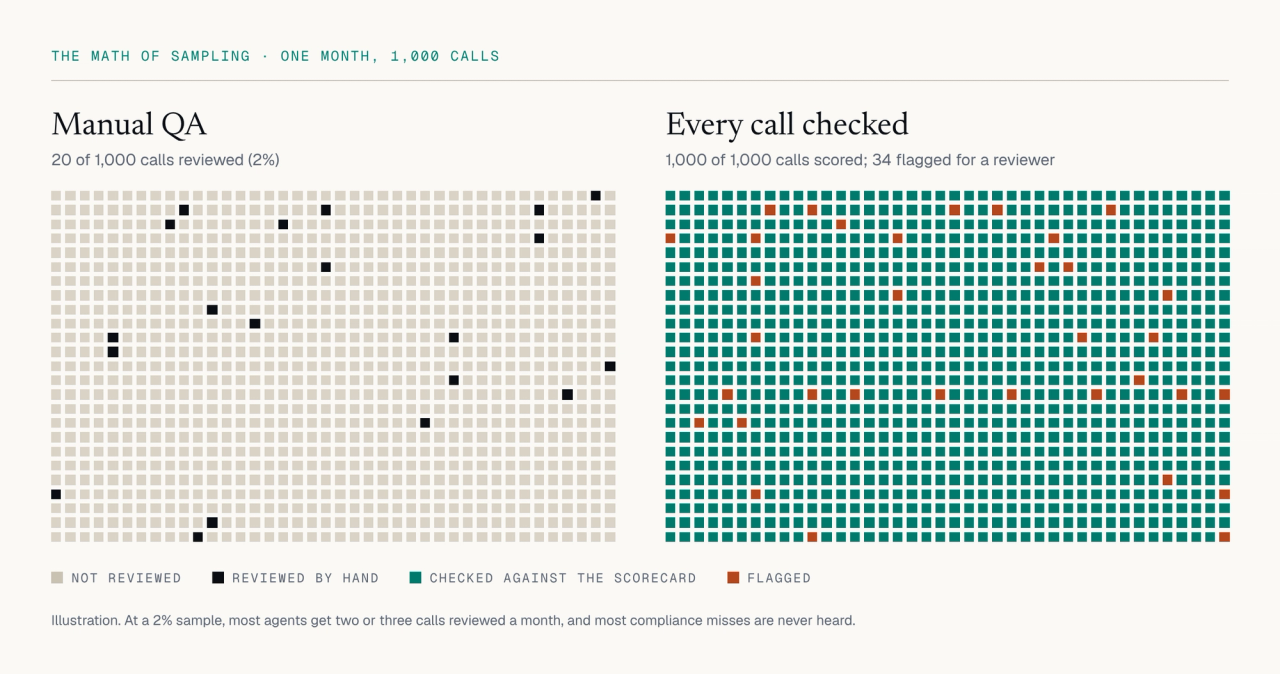
The math of sampling
Take a team of 40 agents, each handling 25 calls a day for 22 working days. That is 22,000 calls a month. A QA team reviewing five calls per agent covers 200 of them, under 1%.
If 1 call in 200 has a serious compliance miss, that month holds about 110 of them. A random 200-call sample will surface one, maybe two. The other 108 stay in the recordings, unheard, until a customer complains or an auditor asks.
That is the core argument for automated QA. It is not about replacing analysts. It is about the 99% of calls nobody hears.
What changes when every call is checked
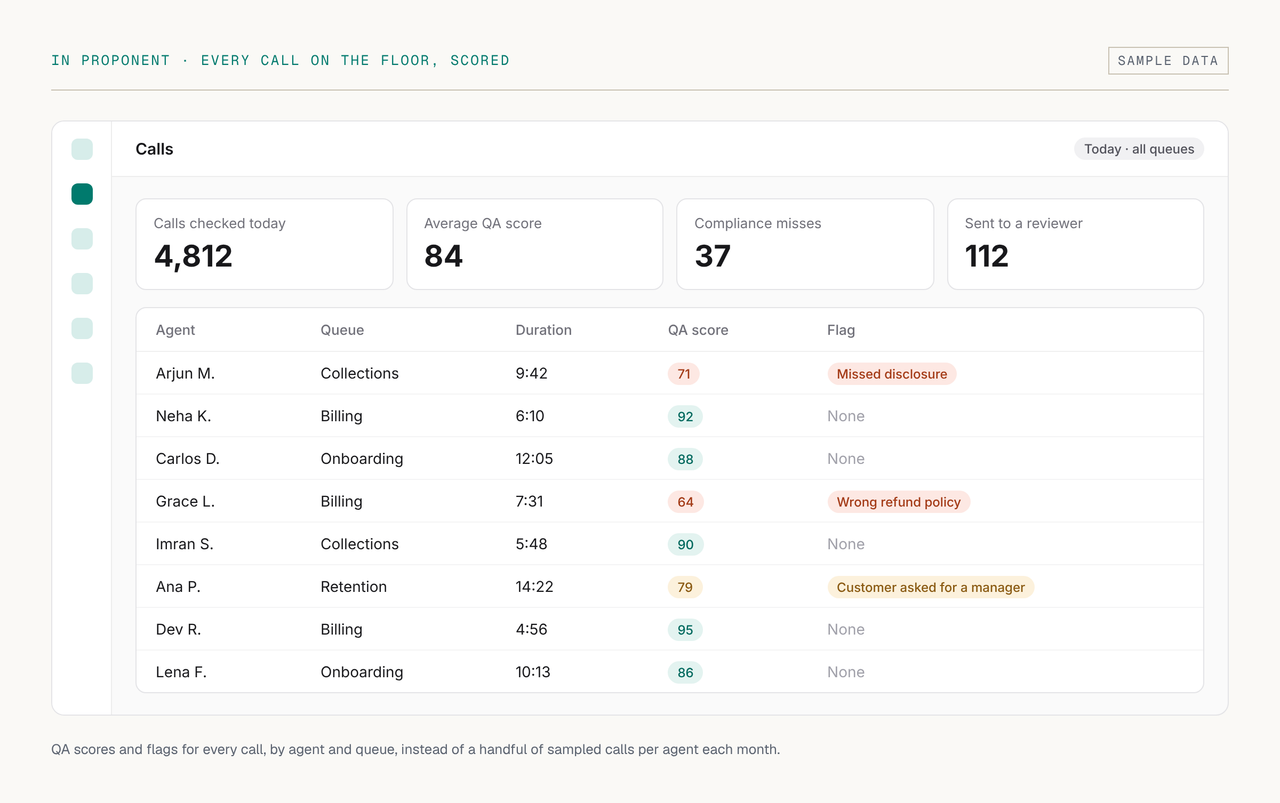
When every call is transcribed and scored against your scorecard, three things change:
- Coverage stops being a choice. Every agent is scored on every call, so a score of 82 means 82 across the month, not 82 on four calls someone picked.
- Analysts move from listening to judging. Instead of spending most of the week finding calls to review, they review the calls the system flagged, settle disputes and coach.
- Patterns become visible. A drop in a verification step across one shift, one queue or one client shows up in days instead of at the next quarterly review.
What does not change: your scorecard is still the standard. Software applies it. People still decide what good looks like.
How to write a scorecard a machine can apply
Most existing scorecards were written for a human reviewer who fills in the gaps. Software does not fill gaps, so the scorecard has to be precise. Four rules work well:
1. Make most checks yes or no
"Did the agent verify the caller's identity before discussing the account?" can be answered from a transcript. "Was the agent professional?" cannot, at least not consistently. Aim for 8 to 15 checks, most of them binary.
2. Say what evidence counts
For every check, write down what the agent has to say or do for it to pass. If a disclosure must be read in full within the first two minutes, say so. The scorer should be able to point to the exact line in the call that passed or failed the check.
3. Separate behavior from outcome
"Agent offered a callback when the issue could not be resolved" is a behavior. "Customer was satisfied" is an outcome. Score behaviors. Track outcomes separately, as insights rather than agent scores.
4. Keep judgment checks, but route them to people
Tone, empathy and handling of a distressed caller matter. Keep them in the scorecard, let the system flag calls where they look off, and have a person make the final call on those.
Here is what a scorecard built this way can look like for an inbound support queue:
| Check | Type | Passes when |
|---|---|---|
| Greeting and name within 15 seconds | Yes/no | Agent states company and own name before the caller explains the issue |
| Identity verified before account details | Yes/no, compliance | Two verification items confirmed before any account data is shared |
| Issue restated back to the caller | Yes/no | Agent summarizes the problem in their own words |
| Required disclosure read in full | Yes/no, compliance | Disclosure text spoken completely, not paraphrased |
| Resolution or next step confirmed | Yes/no | Agent states what happens next and by when |
| Callback offered when unresolved | Yes/no | Offered whenever the issue is not closed on the call |
| Hold over 60 seconds explained | Yes/no | Agent explains why and checks back before 60 seconds |
| Distress or escalation handled | Judgment, human review | Flagged for an analyst whenever the caller asks for a manager or shows distress |
Keep the scores honest: calibration
Before you trust automated scores, calibrate them the same way you calibrate analysts.
- Pick 30 calls across agents and outcomes.
- Have two experienced analysts score them by hand.
- Run the same 30 calls through the system.
- For every check where the system and the analysts disagree on more than a few calls, rewrite the check. Disagreement almost always means the wording is ambiguous, not that the model is broken.
Repeat monthly with a fresh sample. It takes an afternoon, and it is what makes the scores defensible when an agent, a supervisor or a client challenges one.
A 30-day plan to get started
- Week 1: scorecard. Rewrite the current scorecard using the four rules above. Decide which checks are compliance-critical.
- Week 2: connect and backfill. Connect the dialer or recording source and score the last two to four weeks of calls. This gives you a baseline without waiting.
- Week 3: calibrate. Run the 30-call calibration, fix the ambiguous checks, re-score.
- Week 4: go live. Turn on daily scoring, send flagged calls to analysts and share agent-level scores with team leads.
For BPOs and outsourced teams: the client report
If you run calls on behalf of clients, every-call QA changes what you can promise. Instead of a monthly sample report, you can send each client the scores for every call on their line, the compliance flags, and what their customers said, written into their own platform. That is a different conversation at renewal time.
Where Proponent fits
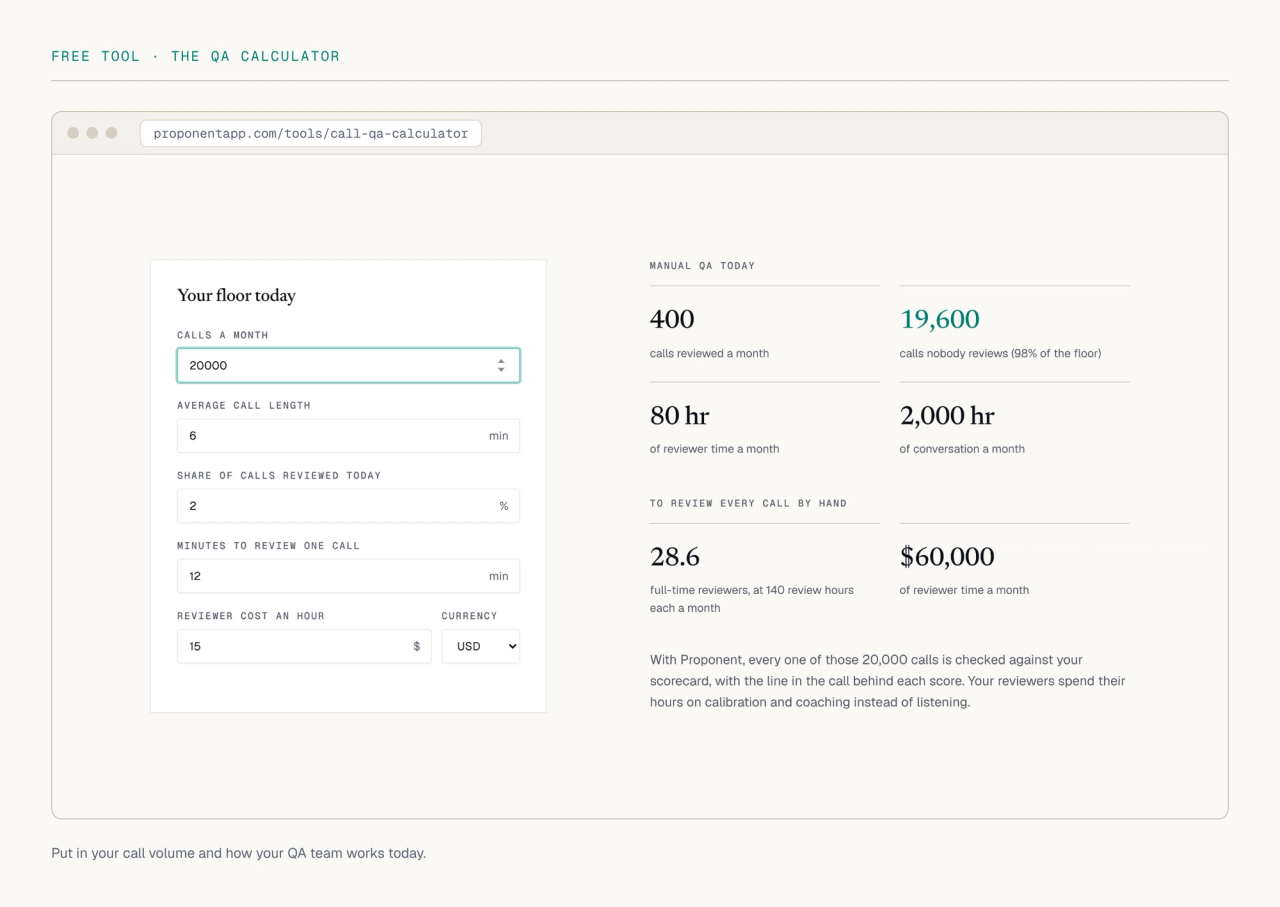
Proponent reads every call against your own QA scorecard, in 80+ languages including mixed-language calls, and writes the result (scores, red flags, a summary, a risk status) into the platform you and your clients already use. Your scorecard stays the standard, and every score links back to the line in the call that earned it. See how voice operations teams use it, or book a demo with a few of your own calls.
Frequently asked questions
What is call center quality assurance?
Call center quality assurance is the process of checking agent calls against a defined scorecard to coach agents, catch compliance risk and measure service quality. Traditionally analysts review a small sample of calls by hand. Automated QA scores every call against the same scorecard.
What percentage of calls should QA review?
Manual programs typically review 2 to 5% of calls, often a few calls per agent per month. With automated QA every call is scored, and analysts review the flagged calls and a calibration sample instead.
Can AI score a QA scorecard accurately?
Yes, for checks that are written precisely: yes-or-no behaviors with clear evidence, such as identity verification or a required disclosure. Subjective checks like empathy work better as flags for human review. Calibrating against analyst scores each month keeps accuracy visible.
Does automated QA replace QA analysts?
No. It replaces the time analysts spend finding calls to listen to. Analysts spend that time on flagged calls, disputes, calibration and coaching.
How long does it take to roll out automated call QA?
A focused team can go live in about four weeks: rewrite the scorecard, connect the call source, backfill recent calls, calibrate on a 30-call sample and then switch on daily scoring.
Get the latest from Proponent Research.
What we learn from analyzing 1M+ calls: QA that covers every call, voice agents that make the routine ones, and the work after the call. One email a month. Leave any time.


