Call QA Scorecard Template: Free Examples for Support, Sales and HR Calls
Three ready-to-use call QA scorecards (support, sales discovery and HR interviews), written so a person or software can score them the same way. Copy the tables or download the PDF.
 Keshav JangidCo-founder, Engineering4 min read
Free download
Get the printable scorecards (PDF).
All three templates on A4, with a scoring guide and a calibration log. We’ll also send the monthly newsletter; leave any time.

A call QA scorecard is the list of checks every call is scored against: what the agent must say or do, how each check is scored and what counts as evidence. A good one gives the same result whether an analyst or software scores the call. This page has three scorecards you can copy and adapt, plus a printable PDF version.
Each template follows the same rules:
- Mostly yes or no. Binary checks score consistently. Keep judgment calls few and label them.
- Evidence written down. Every check says what passes, so a score can point to a line in the call.
- Behavior, not outcome. Score what the agent did. Track outcomes like satisfaction separately.
- Compliance marked. Checks with legal or contractual weight are labelled, so a single miss is flagged even when the overall score is high.
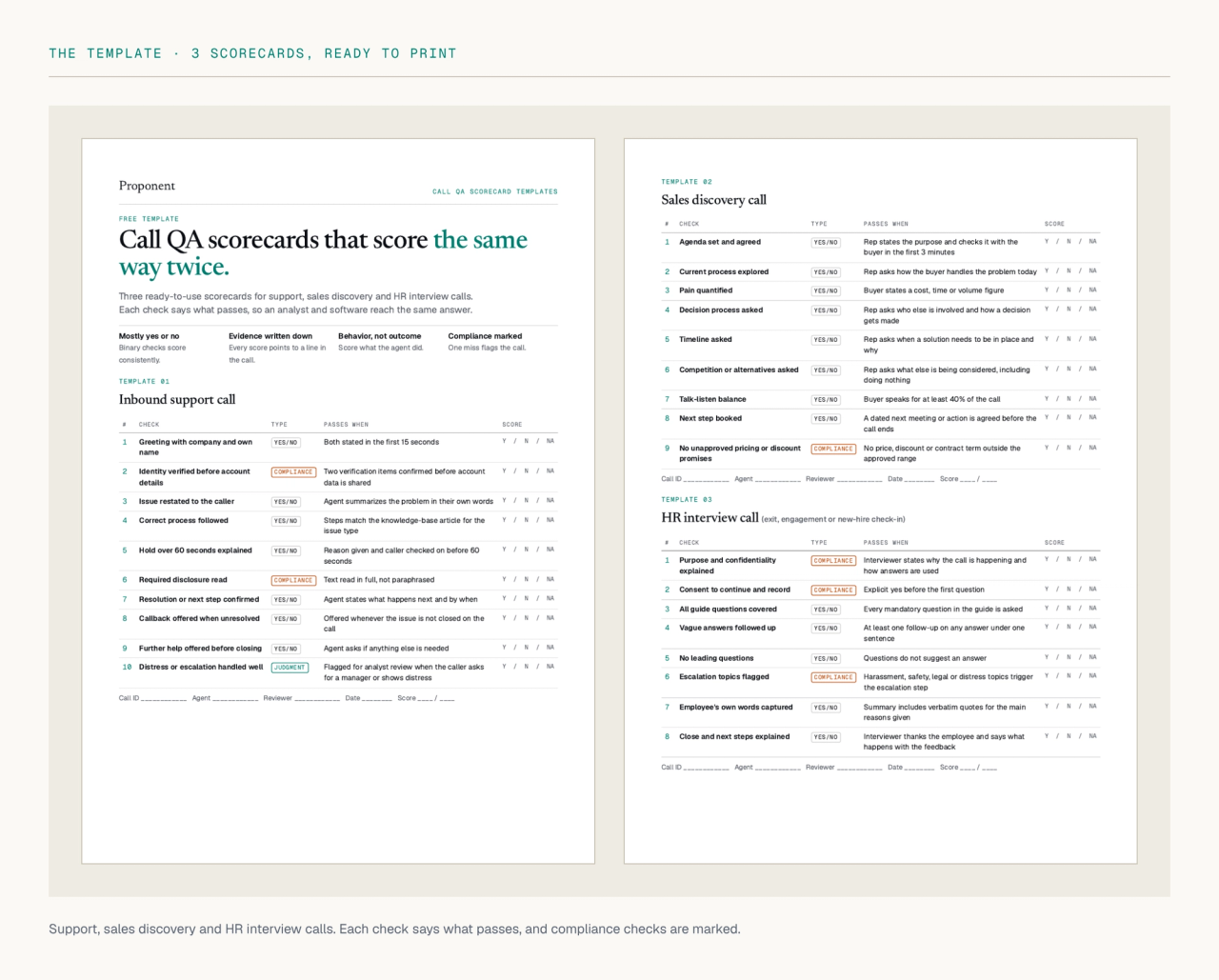
Template 1: inbound support call
| # | Check | Type | Passes when |
|---|---|---|---|
| 1 | Greeting with company and own name | Yes/no | Both stated in the first 15 seconds |
| 2 | Identity verified before account details | Compliance | Two verification items confirmed before account data is shared |
| 3 | Issue restated to the caller | Yes/no | Agent summarizes the problem in their own words |
| 4 | Correct process followed | Yes/no | Steps match the knowledge-base article for the issue type |
| 5 | Hold over 60 seconds explained | Yes/no | Reason given and caller checked on before 60 seconds |
| 6 | Required disclosure read | Compliance | Text read in full, not paraphrased |
| 7 | Resolution or next step confirmed | Yes/no | Agent states what happens next and by when |
| 8 | Callback offered when unresolved | Yes/no | Offered whenever the issue is not closed on the call |
| 9 | Further help offered before closing | Yes/no | Agent asks if anything else is needed |
| 10 | Distress or escalation handled well | Judgment | Flagged for analyst review when the caller asks for a manager or shows distress |
Template 2: sales discovery call
| # | Check | Type | Passes when |
|---|---|---|---|
| 1 | Agenda set and agreed | Yes/no | Rep states the purpose and checks it with the buyer in the first 3 minutes |
| 2 | Current process explored | Yes/no | Rep asks how the buyer handles the problem today |
| 3 | Pain quantified | Yes/no | Buyer states a cost, time or volume figure |
| 4 | Decision process asked | Yes/no | Rep asks who else is involved and how a decision gets made |
| 5 | Timeline asked | Yes/no | Rep asks when a solution needs to be in place and why |
| 6 | Competition or alternatives asked | Yes/no | Rep asks what else is being considered, including doing nothing |
| 7 | Talk-listen balance | Yes/no | Buyer speaks for at least 40% of the call |
| 8 | Next step booked | Yes/no | A dated next meeting or action is agreed before the call ends |
| 9 | No unapproved pricing or discount promises | Compliance | No price, discount or contract term outside the approved range |
Template 3: HR interview call (exit, engagement or new-hire check-in)
| # | Check | Type | Passes when |
|---|---|---|---|
| 1 | Purpose and confidentiality explained | Compliance | Interviewer states why the call is happening and how answers are used |
| 2 | Consent to continue and record | Compliance | Explicit yes before the first question |
| 3 | All guide questions covered | Yes/no | Every mandatory question in the guide is asked |
| 4 | Vague answers followed up | Yes/no | At least one follow-up on any answer under one sentence |
| 5 | No leading questions | Yes/no | Questions do not suggest an answer |
| 6 | Escalation topics flagged | Compliance | Harassment, safety, legal or distress topics trigger the escalation step |
| 7 | Employee's own words captured | Yes/no | Summary includes verbatim quotes for the main reasons given |
| 8 | Close and next steps explained | Yes/no | Interviewer thanks the employee and says what happens with the feedback |
How to weight and score
Keep scoring simple so people trust it:
- Each yes/no check is worth one point. The call score is points earned divided by checks that applied.
- A compliance check that fails flags the call regardless of the score.
- Judgment checks do not count toward the score. They route the call to an analyst.
- Mark checks "not applicable" when they could not apply (no hold, so no hold check), instead of passing them.
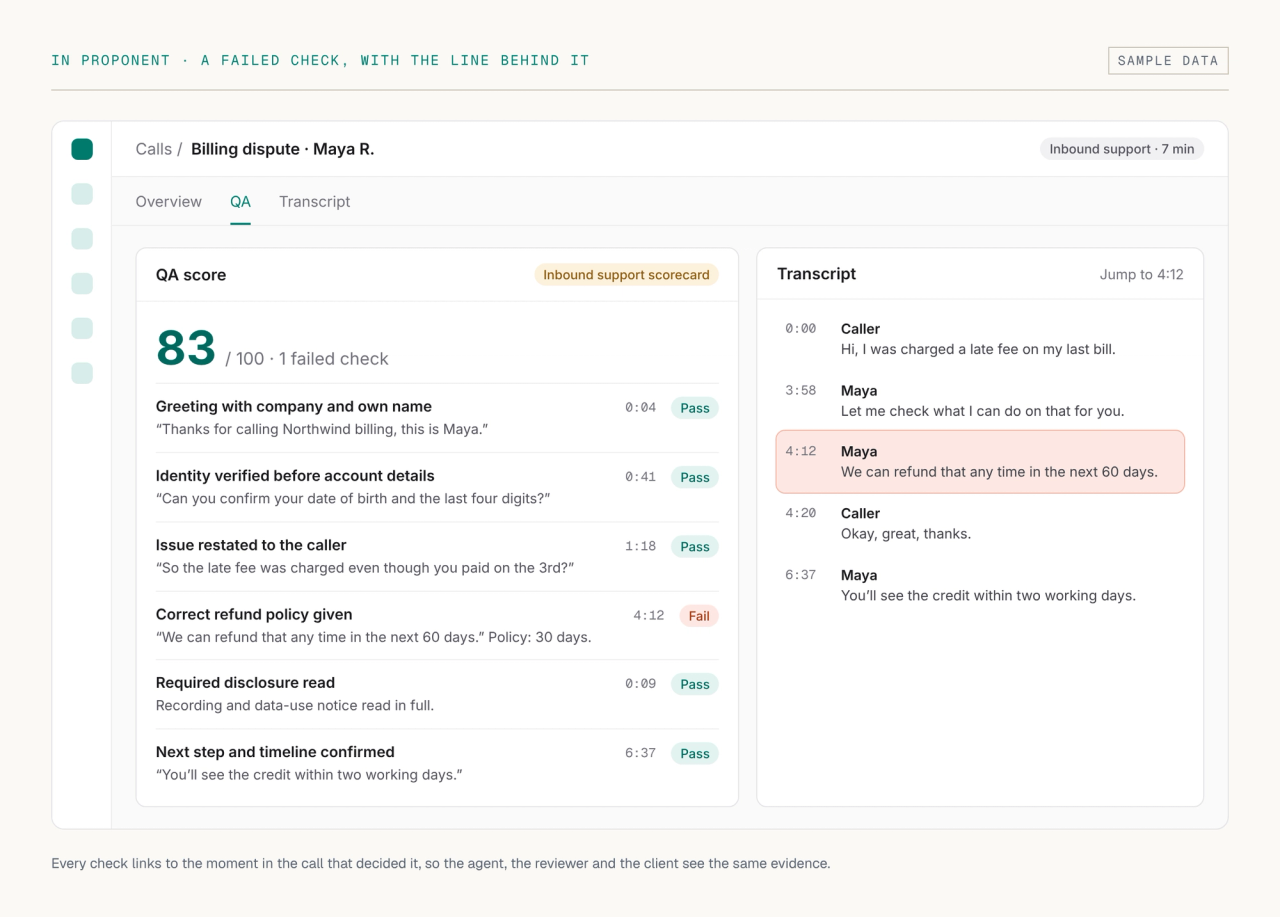
Calibrate before you trust the numbers
Score the same 30 calls with two analysts, then compare. Where the two disagree, the wording of the check is ambiguous. Rewrite it and score again. If you use software to score calls, run the same 30 calls through it and compare in the same way. Repeat monthly.
Score every call, not a sample
These templates work for manual QA. They work better when every call is scored, because a 3% sample rarely catches the compliance misses that matter most. Proponent checks every call against your own scorecard and writes the results into the platform you already use. Read the full guide to call center QA on every call, see how voice operations teams use Proponent, or book a demo.
Frequently asked questions
What should a call QA scorecard include?
A call QA scorecard should list the specific behaviors an agent must show on a call, how each is scored (usually yes or no), what evidence counts as a pass, and which checks are compliance-critical. Eight to fifteen checks is a practical size.
How many items should a QA scorecard have?
Eight to fifteen checks is enough to cover process, compliance and customer experience without making scoring slow or inconsistent. Fewer, sharper checks score more reliably than long lists.
Should a QA scorecard use weights?
Simple scoring with compliance checks as automatic flags is usually clearer than weighted points. If you do weight, keep weights few and document why, so agents understand their score.
Can the same scorecard be used for manual and automated QA?
Yes, if each check is written with clear evidence of what passes. Precise yes-or-no checks score the same way for a person and for software, which is what makes calibration possible.
Free download
Get the printable scorecards (PDF).
All three templates on A4, with a scoring guide and a calibration log. We’ll also send the monthly newsletter; leave any time.


