The prompt is the easy part.
Reading one call is a weekend project. Reading every call, into your CRM, is not.
Deep, but brittle
You can teach it your business. But it learns one job at a time, and every new field, score, or rubric is another sprint on someone's roadmap.
 Proponent
Every call, every workflow, from week one
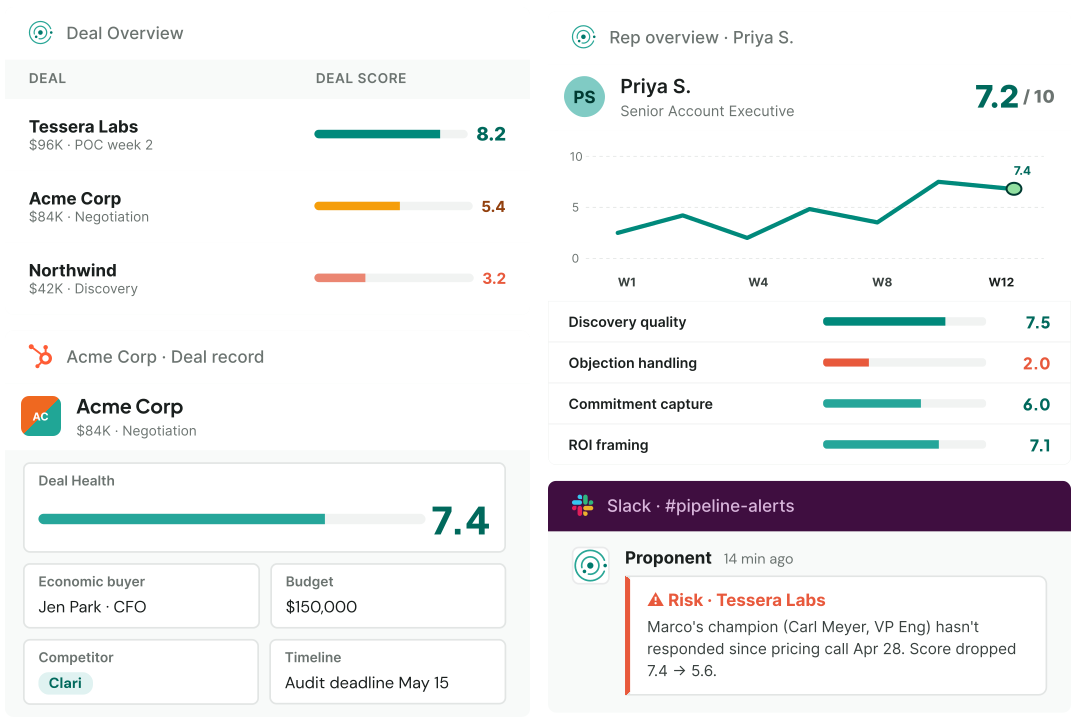
One pass over the conversation updates the CRM, scores the deal, coaches the rep, and assigns the follow-ups. Out of the box, on your playbook.
A transcript is not an update
You get a summary in a doc. A human still has to open the deal, decide what mattered, and type it in. Most weeks, most of them don't.
Broad, but blind
It will answer anything about the calls you paste in. It doesn't know the other four hundred, and it writes nothing back to your CRM.
Why can't I just point Claude at my transcripts?
You can. It works beautifully for the first few calls, then it stops scaling in four specific places.
Read on arrival, not at query time
Every call is processed the moment it lands: fields extracted, deal scored, signals tagged, all written to structured records. A question about last quarter reads those records rather than the raw transcripts, so it spans your whole history instead of whatever fits in a window.
Every callin your history, in one query
They gather context at query time, and a single transcript runs 10–20K tokens. The window fills after a few dozen calls, and everything past that gets sampled or dropped.
~50calls before the window is full
One record holds the whole relationship
Every meeting, dialer call, and in-person conversation attaches to the same customer record, next to the CRM fields, the deal score, and the coaching history. Your team looks in one place, and so does Proponent when it answers a question.
1record per customer, everything on it
They have to work out which tool holds the answer, connect to each one, and stitch the results back together. The CRM, the recorder, email, and the support desk are separate servers, and every user wires up their own.
5+servers to query before an answer
The same rubric on call 400 as on call 4
Proponent qualifies deals against your playbook, whether that's MEDDPICC, BANT, or criteria you wrote yourself. Every deal is scored the same way, with the evidence attached to each slot.
1playbook, applied to every deal
Tune the prompt and last quarter's scores stop comparing to this quarter's. Nobody forecasts on a number that moves when you aren't looking.
Per use casea prompt to write and maintain
Cheaper than the tokens alone
One price covers reading every call and producing all of it: CRM fields, deal scores, coaching, summaries, briefs, and the cross-deal analysis behind win-loss. The integrations, storage, alerts, and SOC 2 come with it. That works out to 4–9× less than the inference by itself.
$0.25per call, everything included
Running the same workloads yourself costs more in model inference alone, at list pricing and without batching. That's before a line of code, a single integration, or an hour of engineering.
$1.00–2.25per call, inference only
The questions that come up next
01Why can't I just connect Claude or ChatGPT to my CRM and transcripts?
You can, and for the first handful of calls it works beautifully. Then you hit three walls.
A single transcript runs 10–20K tokens, so even a large context window holds a few dozen calls. Ask about a quarter and the model is sampling, not reading.
It answers into a chat window, so nothing reaches the deal record unless someone retypes it.
And every user sets up their own connections, so there's no shared definition of a qualified deal and no memory of last week's correction.
02I have good engineers. Why shouldn't they build it?
They can build a convincing demo in a weekend: transcript in, summary out. The distance from there to something you'd let write to Salesforce is where the time goes.
Teams that have tried typically spend $300–500K and two engineers over six months to reach a first version. We've spent 18 months refining extraction, scoring, and CRM sync across 85,000+ real calls, and that part doesn't compress.
The comparison isn't a weekend against six months. It's your engineers' next six months against a two-week pilot.
03We already pay for a notetaker. Isn't this the same thing?
A notetaker gives you a transcript and a summary. Proponent does the work that comes after: CRM fields updated, the deal qualified and scored against your playbook, the rep coached, follow-ups assigned.
If your reps are still reading summaries and retyping the important parts into the deal, the summary was never the bottleneck.
Proponent also works with the recorder you already have, including Gong, Fireflies, and Fathom, so it isn't a rip-and-replace.
04How long until it's actually running?
One admin connects your recorder and CRM. That takes about 15 minutes and no IT involvement.
Proponent starts reading calls immediately, with no field mapping or configuration phase to sit through. You review the qualification criteria and scoring rubric once so they match how your team sells, and from there it runs on every call.
05What happens to my call data?
It's never used to train foundation models. Data is encrypted in transit and at rest, hosted on AWS, and a SOC 2 Type II audit is underway.
We delete everything within 30 days of cancellation and provide a DPA on request. If you need full data residency, Proponent can be self-hosted in your own environment.
06How can you cost less than the tokens?
Because we're not running your workload once. We run it across every customer, and the engineering that makes it efficient is already paid for.
Pre-processing, caching, batching, and routing each job to the right model are the difference between a naive implementation and a tuned one. That's exactly what you'd spend six months building.
You'd be paying retail for inference plus salaries. We buy at scale and amortize the rest.
The comparison is per call at our published Scale rate against the raw model cost of the same outputs, with no engineering time on either side.
07What if we're already partway through building something?
Run them side by side. Proponent connects to the recorder and CRM you already have, so a two-week pilot doesn't disturb the internal build or commit you to anything.
Most teams find the internal project narrows to the one or two things genuinely specific to their business. That's a much better use of two engineers than rebuilding extraction and CRM sync from scratch.
Six months of engineering, or two weeks of evidence.
Connect your recorder and CRM in 15 minutes, no IT required. Proponent runs on every call from day one, and we measure the hours your team gets back. If they aren't there, we end the pilot.