AI Exit Interviews by Phone: A Practical Guide for HR Teams
Exit surveys get ignored and manual exit calls do not scale. Here is how HR teams run exit interviews and engagement check-ins with a voice agent: what to ask, how to handle consent and escalation, and what to report.
 Prashant MohiteCo-founder & CEO5 min read

An AI exit interview is a phone conversation with a departing employee that a voice agent conducts from your HR team's interview guide. It asks the questions, follows up on vague answers, and writes up every call as structured data: the reasons for leaving, risk flags and the employee's own words. HR reads the results instead of making the calls.
This guide is for HR and people-operations teams that already know exit interviews matter but cannot get enough of them done to see a pattern.
Why most exit programs produce so little
Exit feedback usually fails in one of two ways.
Forms get ignored. A departing employee has already mentally left. A ten-question survey in their last week competes with handover, farewell lunches and a new job. Response rates are low and the answers are short.
Calls do not scale. A 20 to 25 minute conversation with a trained interviewer gets honest, detailed answers. It also takes a person most of an hour once you count scheduling, the call and the write-up. Teams with high attrition (retail, logistics, contact centers, field sales) cannot staff that for every leaver, so they call a few and guess about the rest.
The result is the same either way: leadership hears "better opportunity" and "compensation" as the top reasons every quarter, because that is all a thin sample can show.
Why a phone conversation works better than a form
People say more than they type. A conversation also lets the interviewer follow up. "I didn't get along with my manager" becomes useful only when someone asks what happened, how long it went on and whether anyone else on the team felt the same.
A voice agent keeps that advantage and removes the staffing limit. It can call every leaver at a time that suits them, in the language they are most comfortable in, and ask the follow-up questions your guide specifies.
What a voice agent does on an exit call
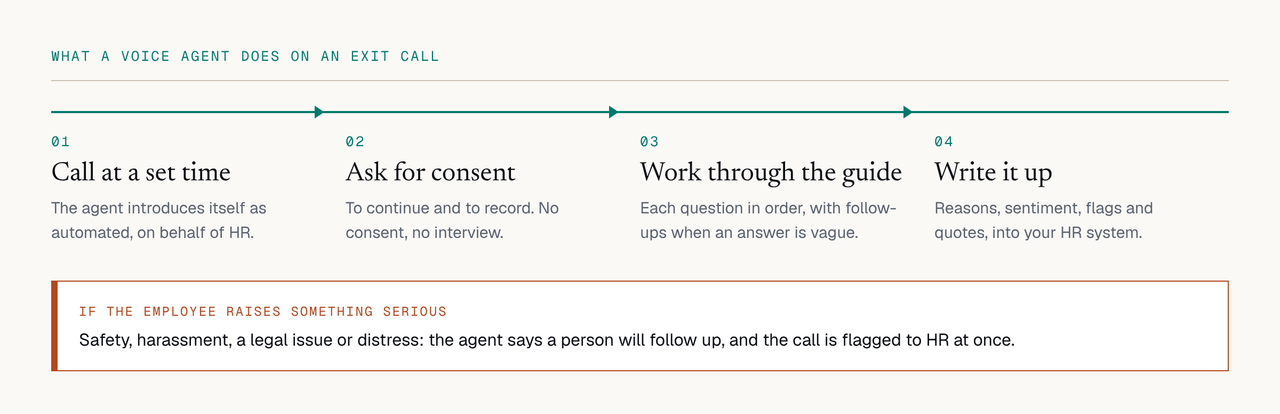
- Calls at a scheduled time, introduces itself as an automated interviewer on behalf of the company and asks for consent to continue and to record.
- Works through your guide, asking each question in order and following up when an answer is vague or mentions something your guide marks as important (a manager issue, a safety concern, harassment).
- Handles detours. If the employee raises something outside the guide, the agent lets them finish and notes it.
- Escalates when it should. If the employee describes something that needs a person (a legal issue, a safety risk, distress), the agent says a member of the HR team will follow up, and the call is flagged immediately.
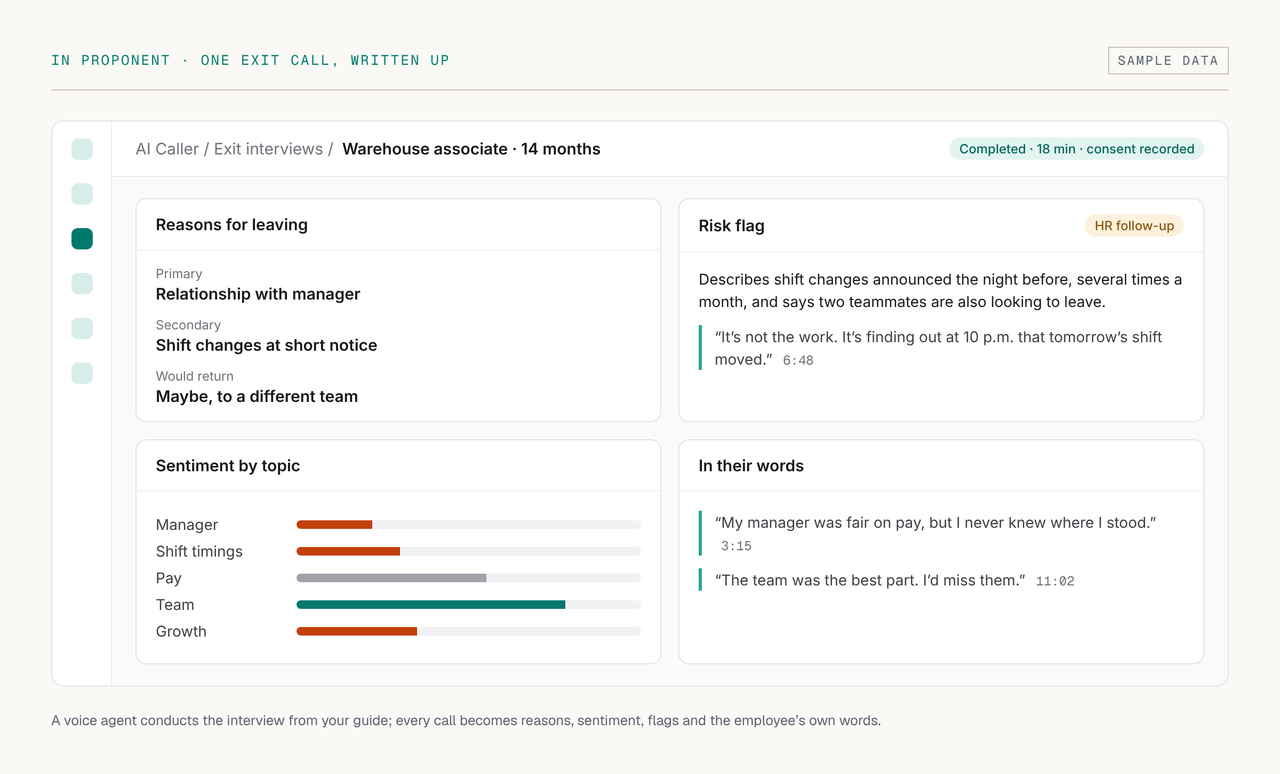
- Writes it up. Every call becomes a record: primary and secondary reasons for leaving, sentiment by topic, risk flags, and verbatim quotes that support each point.
An exit interview guide you can start with
Keep it short. A good phone exit interview runs 10 to 20 minutes and covers eight or nine questions.
- What made you start looking, or say yes to another offer?
- If you could have changed one thing about the role, what would it have been?
- How would you describe your working relationship with your manager?
- Did you feel you had what you needed to do the job well (training, tools, information)?
- How did you feel about your workload over the last few months?
- Was there a moment when you decided to leave? What happened?
- Would you recommend this company to a friend as a place to work? Why or why not?
- Would you consider coming back in the future?
- Is there anything you want the leadership team to hear directly?
For each question, write down what a useful answer contains and when the agent should probe further. That instruction is what separates a real interview from a survey read aloud.
Consent, privacy and escalation
Get these right before the first call:
- Say it is automated. The agent should introduce itself as an AI interviewer at the start of the call.
- Ask for consent to the interview and to the recording, and end politely if the answer is no.
- Tell people how answers are used: aggregated for trends, with individual comments shared only as your policy allows.
- Define the escalation list (harassment, discrimination, safety, legal threats, distress) and who in HR gets the flag, with a response time.
- Check local rules on call recording and employee data before you start. Your legal team will want to see the script.
What to report, and to whom
The point of calling every leaver is that the numbers finally mean something. A monthly exit report that leadership will read usually has:
- Reasons for leaving, by team, location and manager, with the change from last month.
- The share of leavers who would return or recommend the company.
- Risk flags raised and how fast HR followed up.
- Five to ten verbatim quotes that explain the numbers.
Beyond exits: engagement check-ins and new-hire calls
The same setup works earlier in the employee journey, which is where it pays for itself:
- New-hire check-ins at 30, 60 and 90 days catch early attrition while there is still time to act.
- Monthly engagement calls give HR a pulse on teams that never fill in surveys.
- Stay interviews with high performers surface the issues before they become exit reasons.
Where Proponent fits
Proponent Voice Agents conduct these calls from your own interview guide. They are multilingual, run on your dialer and write up every call into the platform your HR team already uses, with each finding linked to the words that support it. The Sleep Company runs its monthly employee engagement program on Proponent Voice Agents: 2,500 interviews a month, about 25 minutes each, with engagement rates 30% higher. See how Proponent Voice Agents work, or book a demo.
Frequently asked questions
What is an AI exit interview?
An AI exit interview is a conversation with a departing employee conducted by a voice agent from the HR team's interview guide. The agent asks the questions, follows up on vague answers and turns the call into structured data such as reasons for leaving, risk flags and supporting quotes.
Will employees talk honestly to an AI interviewer?
Many find it easier to be candid with an automated interviewer than with a colleague, especially about their manager. Telling people up front that the interviewer is automated and how their answers are used is important for trust.
How long should a phone exit interview be?
Ten to twenty minutes covers eight or nine questions with follow-ups. Longer calls lose people; shorter ones lose the follow-up questions that make the answers useful.
What happens if an employee raises a serious issue?
A well-configured voice agent recognizes topics on an escalation list, such as harassment, safety or legal issues, tells the employee that someone from HR will follow up, and flags the call for a person immediately.
Can the same voice agent run engagement surveys?
Yes. The setup is the same: an interview guide, consent at the start and a written record of each call. New-hire check-ins, monthly engagement calls and stay interviews are common next steps after exit interviews.
Get the latest from Proponent Research.
What we learn from analyzing 1M+ calls: QA that covers every call, voice agents that make the routine ones, and the work after the call. One email a month. Leave any time.


