What Is Revenue Intelligence? A Plain-English Guide for 2026
Revenue intelligence turns call, CRM, and deal data into one accurate picture of what's actually going to close. What it means and how it works.
 Prashant MohiteCo-founder & CEO8 min read
Revenue intelligence is the practice of using AI to analyze sales calls, CRM activity, and deal data together, so a forecast reflects what buyers actually said instead of what a rep remembered to log. It replaces gut-feel pipeline reviews with evidence: every deal score, every risk flag, and every coaching note traces back to a specific moment in a specific call. A revenue intelligence platform is the software category that does this automatically, across every deal, every rep, and every call, not just the ones a manager happened to sit in on.
This guide covers what revenue intelligence actually means, how it differs from the adjacent terms it gets confused with, what the software does in practice, and what to look for if you're evaluating a platform.
What Is Revenue Intelligence?
The average B2B sales team is running its pipeline on incomplete information. CRM records are famously thin: the average CRM is only about 35% complete, and most sales managers review something like 2% of the calls their reps actually have. The other 98% either goes unreviewed or gets summarized secondhand, filtered through whatever the rep remembered to type into a dropdown after the call ended.
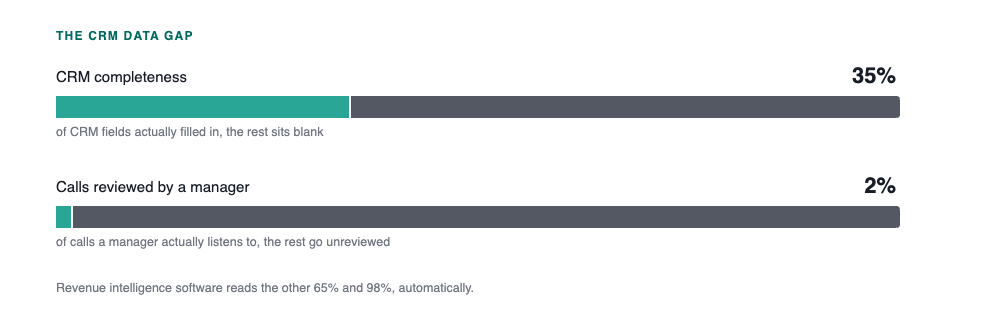
Revenue intelligence closes that gap. Instead of relying on a rep's memory or a manager's spot checks, it reads every call and every CRM update, and turns that raw activity into structured signal: which deals are healthy, which are at risk, why, and what changed since last week. The "intelligence" part is the analysis layer on top of the transcript: scoring, pattern-matching against a qualification framework, and surfacing what a human reviewing the same volume of calls would take weeks to find.
It's worth separating this from plain sales analytics or a BI dashboard. A dashboard aggregates numbers that already exist in the CRM: deal stage, deal age, close date. Revenue intelligence generates new signal that didn't exist in the CRM before, by reading the actual conversation and extracting facts a rep never typed in: the objection that came up twice, the competitor mentioned by name, the buyer who went quiet when asked about budget.
How Does Revenue Intelligence Work?
Most revenue intelligence platforms follow the same basic pipeline, even though the specifics vary:
- Capture. The platform connects to wherever sales conversations happen, video calls, dialers, in-person meetings, and records or ingests them.
- Transcribe and structure. Speech becomes text, and the transcript gets broken into speakers, topics, and moments (an objection, a pricing discussion, a next-steps commitment).
- Analyze. This is where the "intelligence" happens. The platform scores the deal against a qualification framework, commonly MEDDPICC, BANT, or a custom model, and flags gaps: a deal with no confirmed economic buyer, a champion who's gone quiet, a competitor mentioned that wasn't there last quarter.
- Act. The output gets pushed somewhere useful: CRM fields update automatically, a Slack alert fires when a deal turns risky, a rep gets a coaching note on their talk-to-listen ratio, a forecast rolls up deal scores instead of rep-reported gut feel.
How AI deal scoring works goes deeper on that middle "analyze" step specifically, since it's the part that separates a real revenue intelligence platform from a glorified call recorder.
Revenue Intelligence vs. Conversation Intelligence vs. Customer Intelligence: What's the Difference?
These three terms get used almost interchangeably in vendor marketing, but they answer different questions.
Conversation intelligence is the narrowest of the three. It's about a single call or meeting: what was said, by whom, what the sentiment was, whether a competitor got mentioned. It's the capture-and-transcribe layer, plus some per-call analysis.
Customer intelligence is broader and points a different direction. Instead of asking "what happened on this call," it asks "what are buyers telling us across hundreds of calls, over time." What is customer intelligence covers this in full, but the short version: it's aggregated buyer signal used mostly by product and product marketing teams to inform positioning, messaging, and roadmap, not to run today's pipeline.
Revenue intelligence sits on top of conversation-level data but asks a narrower, closing-focused question: will this deal close, and why. It ties call-level signal to deal stage, rep performance, and forecast accuracy, so it's the layer sales leadership actually lives in.
In practice, most platforms blend all three to some degree, and the label a vendor picks often reflects who they're selling to more than a hard technical boundary. A tool marketed to product marketers calls itself customer intelligence. The same underlying call data, sold to a VP of Sales, gets called revenue intelligence.
| Conversation Intelligence | Customer Intelligence | Revenue Intelligence | |
|---|---|---|---|
| Scope | One call or meeting | Buyer signal across many calls, over time | Deal-level and rep-level signal across the pipeline |
| Core question | What was said? | What are buyers telling us? | Will this deal close, and why? |
| Primary data source | The call transcript | Calls, plus surveys and other buyer touchpoints | Calls, plus CRM and deal data |
| Primary user | Reps and managers, per call | Product and product marketing | Sales leadership and RevOps |
What Does Revenue Intelligence Software Actually Do?
Stripped of the category-marketing language, a revenue intelligence platform typically does four things:
- Updates the CRM automatically. Competitor mentioned, objection raised, budget discussed, next steps agreed, all pulled from the call and written into CRM fields without a rep typing anything.
- Scores deal health. Every open deal gets qualified against a framework like MEDDPICC and assigned a score, with the reasoning traceable back to the exact call moment that drove it.
- Coaches reps at scale. Every call, not a sampled 2%, gets scored on discovery depth, objection handling, and talk-to-listen ratio, so coaching reaches the reps who actually need it.
- Improves forecast accuracy. Deal scores and risk flags roll up into a pipeline view built from evidence instead of rep-reported confidence, with win-rate breakdowns by competitor, objection, or segment.
CRM automation, deal scoring, and coaching, all running off the same call data, is what distinguishes revenue intelligence from a standalone recorder or transcription tool. The recording is the input. The four capabilities above are the point.
Who Actually Uses Revenue Intelligence?
The label suggests a sales-leadership tool, and it usually starts there, but the actual usage spreads wider once it's in place.
VPs of Sales and CROs use it for forecast accuracy: a pipeline built from deal scores grounded in call evidence is harder to sandbag or oversell than one built from rep-reported confidence.
RevOps uses it to fix the CRM-completeness problem directly. Instead of chasing reps to fill in fields after the fact, the fields get written from the call itself, which is also why RevOps teams tend to be the ones evaluating platforms in the first place.
Sales managers use the coaching layer: a scored call library means coaching conversations start from specific moments (a missed discovery question, a rushed objection response) instead of a manager's general impression from whichever call they happened to catch live.
Product marketing and competitive intelligence teams often pull from the same underlying data: win-rate by competitor, objection frequency, feature requests mentioned on calls, even though that use case leans closer to customer intelligence than revenue intelligence proper (see the distinction above).
How to Choose a Revenue Intelligence Platform
A few things are worth checking before committing to one:
Does it integrate with what your team already uses? Recorders, dialers, and CRMs vary by team, and a platform that requires reps to change how they work will see lower adoption than one that plugs into existing tools.
Is the scoring grounded in a named framework, or a black box? A deal score that traces back to MEDDPICC criteria (or BANT, or whatever framework your team already runs) is auditable. A score with no visible logic is harder to trust and harder to debug when it's wrong.
Can you trace a score back to the call it came from? "AI hallucinates" is the most common objection to any of this, and it's a fair one. Don't take the score on faith. Check whether the platform links every field, score, and alert back to the specific moment in the call that produced it, so a rep or manager can verify it in seconds instead of trusting a number with no paper trail.
How does pricing scale? This one matters more than it looks on a feature comparison chart. Most conversation and revenue intelligence tools charge per seat, which means the bill grows every time the team hires, whether or not the new rep is generating calls worth analyzing yet. Proponent prices on call volume for the whole org instead: plans start at $149/mo and scale with calls processed, versus a blended $125-167 per seat, per month for typical per-seat AI sales tools like Gong, HubSpot AI, and Agentforce. For a 30-rep team, that's the difference between a fixed, predictable tier and a bill that climbs in lockstep with headcount. The full pricing breakdown has the exact tiers.
| Team size | Proponent (whole org, call volume) | Typical per-seat tools (Gong, HubSpot AI, Agentforce) |
|---|---|---|
| 5 reps | $399/mo (Growth tier) | $625-835/mo |
| 30 reps | $999/mo (Scale tier) | $3,750-5,010/mo |
| 120 reps | ~$3,190/mo (Enterprise, custom) | $15,000-20,040/mo |
Estimates: ~133 calls/rep/month against Proponent's call-volume tiers vs. $125-167/seat/month for typical per-seat AI sales tools (Gong, HubSpot AI, Agentforce).
If you're evaluating platforms for your own team, booking a walkthrough is the fastest way to see how the scoring and CRM automation actually hold up against your own calls, not a demo script.
Frequently asked questions
Is revenue intelligence the same as conversation intelligence?
No, though the two overlap. Conversation intelligence analyzes what happened on a specific call or meeting. Revenue intelligence uses that call-level data, plus CRM and pipeline data, to answer a broader question: which deals will close, and why. Most revenue intelligence platforms include conversation intelligence as one input, not the whole product.
Do I need a dedicated revenue intelligence platform, or can my CRM do this natively?
It depends on how much of the workflow you need automated. Native CRM call-logging features can capture and summarize individual calls. A dedicated platform typically goes further, scoring deals against a qualification framework, auto-filling multiple CRM fields from a single call, and coaching reps at scale. That's harder to bolt onto a CRM's built-in call feature.
How much does revenue intelligence software cost?
Pricing models vary by vendor. Most tools in the category charge per seat, commonly in the $125-167 per rep, per month range for AI-driven sales tools like Gong, HubSpot AI, and Agentforce. Some platforms, including Proponent, price by call volume for the whole org instead, which changes the total cost curve as a team grows.
What's the difference between revenue intelligence and sales forecasting?
Forecasting is the output: a prediction of what will close and when. Revenue intelligence is the system that produces the inputs a forecast is built from: deal scores, risk flags, and win-loss patterns grounded in what buyers actually said, rather than a rep's self-reported likelihood to close.
Can revenue intelligence work with any CRM?
It depends on the platform's integrations, not the concept itself. Most revenue intelligence tools are built to write back into a specific set of supported CRMs, commonly Salesforce, HubSpot, and a handful of others, so it's worth confirming your CRM is supported before evaluating further.
Does revenue intelligence replace a sales manager's call reviews?
No, it changes what's possible to review. Most managers can only manually review a small fraction of their team's calls. Revenue intelligence software scores every call, so managers can spend their limited review time on the calls the data flags as highest-risk or highest-learning, instead of whichever ones they happened to sit in on.
Is revenue intelligence only useful for enterprise sales teams?
No, though the value compounds with deal complexity and team size. Smaller teams still get value from the CRM-automation and coaching side even without complex, multi-stakeholder deals. The forecasting and deal-scoring side becomes more valuable as pipeline volume and deal complexity grow.