Chorus vs Proponent: Which One Fits Your Sales Team?
Chorus sells conversation intelligence bundled into ZoomInfo, at a custom quote-only price. Proponent scores deals, updates your CRM, and coaches reps at one flat rate.
 Bhumika GohilHead of Revenue7 min read
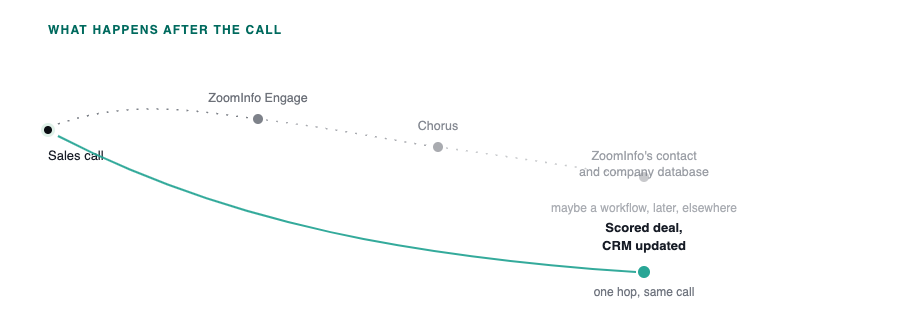
Chorus was one of the original conversation intelligence platforms, acquired by ZoomInfo for roughly $575 million in 2021 and sold today as "Chorus by ZoomInfo," built into ZoomInfo's broader go-to-market data platform. Proponent is built around a narrower job: read every sales call, score the deal against MEDDPICC, update the CRM, and coach the rep, at a price that stays flat as you add seats. Both start with the call. What each one turns that call into is where they split.
Chorus grew up as conversation intelligence: recording, transcribing, and analyzing how a call went. Proponent is built around customer intelligence: what buyers actually said, turned directly into an updated deal record, a MEDDPICC score, and a coached rep. The practical difference shows up in pricing, in who is driving the roadmap since the ZoomInfo acquisition, and in how much of the analysis becomes usable work versus a searchable archive.
Why Teams Compare Chorus and Proponent
Chorus and Proponent start from the same premise: sales calls hold the real story of a deal, and most of it never makes it into the CRM. Reps forget to log a competitor mention or a budget objection. Managers can only sit in on a handful of calls a week. Forecasts end up built on what a rep remembers saying, not on what the buyer actually said.
Where the two diverge is who owns the roadmap, how the platform is priced, and how much of the call analysis turns into usable work product instead of a searchable archive nobody revisits.
What Chorus Does Well
Chorus earned its reputation before the acquisition, and the core product still holds up well. It records and transcribes calls across Zoom, Microsoft Teams, Google Meet, and phone or dialer conversations, then surfaces deal intelligence, coaching workflows built from top-performer call libraries, and competitive mention tracking that flags how reps talk about rivals in real time.
Since ZoomInfo's roughly $575 million acquisition of Chorus (then AffectLayer Inc.) in 2021, the platform has been pulled into ZoomInfo's wider go-to-market suite. Calls taken through ZoomInfo Engage sync directly into Chorus, and Chorus's own conversation data is layered against ZoomInfo's contact and company database, so a competitor mention or a buying-committee shift on a call can trigger a targeting or outreach workflow elsewhere in the ZoomInfo platform. For a team already standardized on ZoomInfo for contact data, that depth of integration is a real advantage, and it shows up in the reviews: Chorus holds roughly a 4.5 star rating across nearly 3,000 G2 reviews.
Where Chorus Gets Expensive
That integration comes at a cost, starting with the fact that there is no public price to compare against. Chorus, like Gong, does not list pricing anywhere on its site. ZoomInfo sells it through a sales-qualified custom quote, typically scoped alongside or bundled into a broader ZoomInfo contract. G2 reviewers consistently flag pricing as one of the platform's biggest downsides, describing it as among the higher end of the conversation intelligence category. Treat any specific figure you find online for Chorus as an estimate, not a quote, since ZoomInfo does not publish one.
The bigger structural issue for a lot of teams: since the acquisition, Chorus's product direction has increasingly tied itself to ZoomInfo's own contact and intent data. If your team does not already run on ZoomInfo for prospecting, or does not want to, a meaningful share of what you would be buying is integration value you cannot use.
What Proponent Does Differently
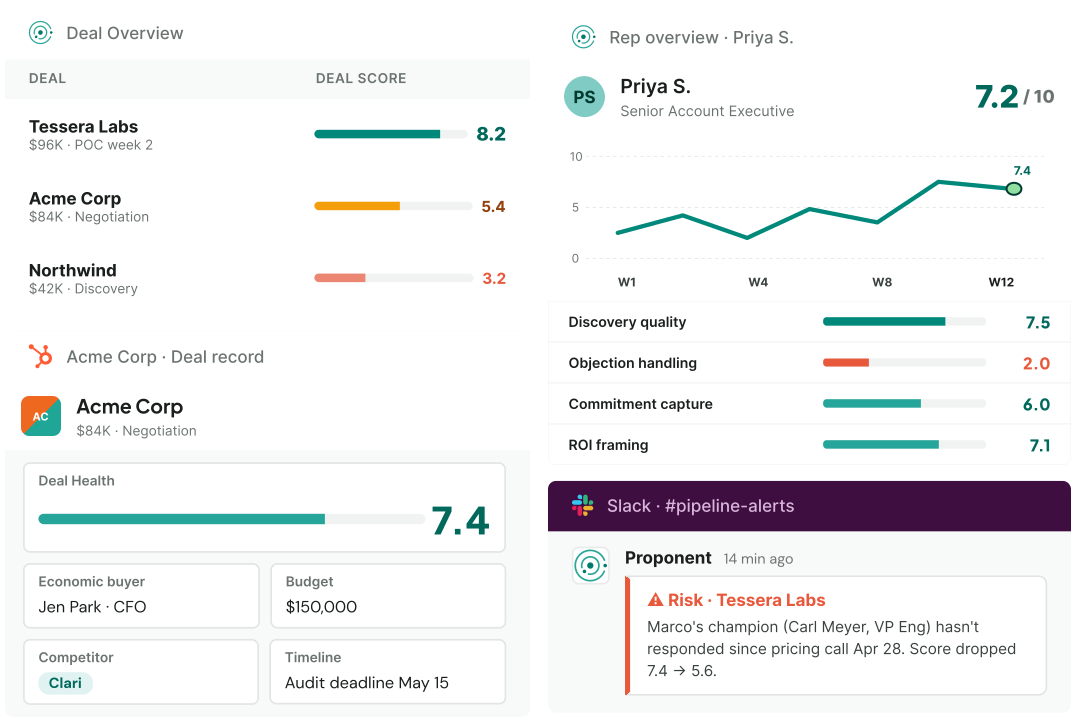
Proponent reads every sales call and does the work between conversations: your CRM gets updated, every deal gets scored against MEDDPICC, and every rep gets coached, not just the ones a manager had time to review.
- Deal health, scored against MEDDPICC. Every deal is qualified against MEDDPICC, BANT, or your own criteria, with a health score grounded in what was actually said on the call, not what a rep remembered to log.
- The CRM writes itself. Competitor mentions, objections, budget, and next steps are extracted from the call and written back to HubSpot, Salesforce, Zoho, Attio, or Pipedrive automatically.
- Every rep coached, on every call. Discovery quality, objection handling, and talk to listen ratio are scored on 99%+ of calls, not the handful a manager can sit in on live.
- Works with the recorder you already have. Proponent connects to Zoom, dialers, and in-person or phone conversations through its mobile app, with no dedicated meeting bot and no ZoomInfo relationship required.
- Priced for the whole org, not tied to a data platform. Pricing is based on calls processed, not per-seat licensing and not bundled with a contact database, so marketing, ops, and leadership can all use it without adding headcount cost or buying data they do not need.
- Published pricing, visible before any sales call. Every tier and its call volume is listed publicly, so you know the number before you talk to anyone.
Chorus vs Proponent, Side by Side
| Chorus | Proponent | |
|---|---|---|
| Recording | Own meeting bot, plus ZoomInfo Engage integration | Works with the recorder, dialer, or meeting tool you already use |
| Pricing model | Custom quote, sales-negotiated, often scoped alongside a ZoomInfo contract | Published online, by calls processed, unlimited seats included |
| Deal intelligence | Conversation data layered against ZoomInfo's contact and company database | MEDDPICC (or your methodology) scored automatically on 99%+ of calls |
| CRM updates | Syncs conversation and contact data to CRM and ZoomInfo Engage | Competitor, objection, budget, and next steps written to the deal record automatically |
| Contract structure | Annual, sales-negotiated, commonly bundled with a broader ZoomInfo agreement | Two-week pilot, no long-term commitment |
| Best fit | Teams already standardized on ZoomInfo for contact and intent data | Teams that want deal scoring and CRM automation without a data-platform bundle attached |
What This Actually Costs
Proponent's pricing is public: the Scale tier, built for roughly 4,000 calls a month, enough to cover a 30-rep team at full volume, is $999 a month, with every seat across sales, ops, marketing, and leadership included at no extra cost. That number is listed publicly, no sales call required.
Chorus does not publish a comparable number. ZoomInfo prices it through a custom quote, and what leaks out is directional, not exact: G2 reviewers repeatedly describe it as one of the pricier tools in the category, and third-party SaaS pricing research puts typical per-seat costs in the low four figures annually, before implementation and any ZoomInfo data bundle. That would put a 30-rep team's Chorus bill well above Proponent's flat rate on a seat-for-seat basis, but it is not a number ZoomInfo will confirm without a sales call, so treat it as a directional signal, not a budget you can plan against.
| Chorus | Proponent Scale tier | |
|---|---|---|
| Price published online | No, quote required | Yes, listed at proponentapp.com/pricing |
| Typical buyer profile | Enterprise teams already standardized on ZoomInfo | Teams from roughly 15 to 100+ reps |
| Seats included at quoted price | Priced and scoped per seat | Unlimited: sales, ops, marketing, leadership |
| Contract commitment | Annual, sales-negotiated | Two-week pilot, no long-term commitment |
Pricing figures above are accurate as of July 2026 and may change. Chorus's pricing is not published, so confirm current rates directly with ZoomInfo before budgeting around any third-party estimate; confirm Proponent's current rates at proponentapp.com/pricing.
That gap compounds the moment anyone outside the sales team, customer success, product, or ops, wants visibility into what the calls actually revealed.
Which One Should You Choose
Choose Chorus if your team is already standardized on ZoomInfo for contact and intent data, you have the budget and rep count to justify an enterprise, sales-negotiated contract, and you specifically want conversation intelligence layered against ZoomInfo's own buying-committee data.
Choose Proponent if you want MEDDPICC-based deal scoring, rep coaching, and CRM automation running on every call, not just the ones someone chooses to review, at a price you can see before you talk to sales, and without being tied to a particular data platform to get there.
The fastest way to find out which is right for your team: run both against your own calls. Proponent's two-week pilot connects to your existing recorder and CRM in about 15 minutes, with no long-term contract, so you can see what it surfaces before you decide anything.
For a similar breakdown against a more sales-focused conversation intelligence platform, see our comparison of Gong vs Proponent, or read how MEDDPICC scoring actually works before you evaluate either platform's deal intelligence claims.
Frequently asked questions
Is Chorus the same company as ZoomInfo?
No, though it is now owned and sold by it. ZoomInfo acquired Chorus.ai, then operating as AffectLayer Inc., for roughly $575 million in 2021, and the product is marketed today as "Chorus by ZoomInfo," integrated into ZoomInfo's broader go-to-market platform rather than run as an independent company.
Do I need a ZoomInfo subscription to use Chorus?
Chorus can technically be sold on its own, but a meaningful share of its differentiated value (buying-committee data, targeting triggered by keyword mentions, syncing with ZoomInfo Engage) depends on ZoomInfo's contact and company database. Teams not already on ZoomInfo often end up evaluating a bundle rather than a standalone conversation intelligence tool.
How much does Chorus cost?
ZoomInfo does not publish pricing for Chorus. It is sold through a custom, sales-negotiated quote. G2 reviewers frequently describe it as one of the pricier options in the category, and third-party research estimates typical costs in the low four figures per seat annually, but none of that is confirmed without a call to ZoomInfo sales.
Can I switch from Chorus to Proponent?
Yes. Proponent connects to your existing CRM (HubSpot, Salesforce, Zoho, Attio, or Pipedrive) and works with whatever recorder or dialer you already use, including running alongside Chorus during a pilot so you can compare outputs directly before switching anything.
Does Proponent do deal intelligence the way Chorus does?
Both turn conversations into deal-relevant signal, but the mechanism differs. Chorus's deal intelligence leans on layering conversation data against ZoomInfo's contact and company database. Proponent scores every deal directly against a sales methodology, MEDDPICC by default, using what was said on the call itself, without requiring a separate contact-data platform underneath it.
Is Proponent's pricing really per call, not per seat?
Yes. Every plan includes unlimited users across sales, ops, marketing, and leadership; the price scales with call volume, not headcount. Hiring ten more reps does not move the bill the way it would under a per-seat model.
Which one is better for a team that is not using ZoomInfo for prospecting?
Generally Proponent, since it does not require any particular data platform underneath it to deliver its core deal scoring and CRM automation. Chorus's most distinctive features are built specifically around ZoomInfo's own contact and intent data, so a team without that underlying subscription gets a narrower slice of what Chorus is designed to do.