How AI Deal Scoring Works (and Why Gut Feel Forecasts Fail)
AI deal scoring turns what's actually said in sales calls into a real-time health score for every deal. Here's how it works, why gut-feel forecasts miss, and what a trustworthy score is actually built from.
 Keshav JangidCo-founder, Engineering5 min read
AI deal scoring is a health score generated from what actually happens in a deal, not from a stage a rep clicked in the CRM. It's built from signals in sales calls, emails, and account activity: who's engaged, what's been said about competitors, whether the timeline is moving or drifting. It exists because gut-feel forecasting, the kind built from a rep's confidence level and a manager's adjustment on top, is wrong often enough that most sales leaders don't trust it.
What Is AI Deal Scoring?
AI deal scoring assigns a deal a health score, usually alongside a win-probability estimate, based on evidence rather than a rep's self-report. Instead of asking a rep how they feel about a deal, it looks at what was actually said and done: has the economic buyer spoken on a call, has a champion been identified and is that person acting like one, has a competitor come up in the last three conversations, has the expected close date moved twice already.
This is different from the stage-based forecasting most CRMs run by default. Stage-based forecasting assumes every deal in "Proposal" is roughly as far along as every other deal in "Proposal." It isn't. One of those deals has a signed mutual action plan and an economic buyer who's asked for a contract redline. The other has a rep who moved the stage forward because the quarter was ending and the deal felt close. Stage tells you where a rep says a deal is. A deal health score tells you what's actually happened in it.
Why Do Gut-Feel Forecasts Fail?
Gut-feel forecasting fails for a structural reason, not a discipline problem: everyone who touches the number has an incentive to distort it. Reps sandbag, deliberately understating a deal's likelihood so a later "surprise" win looks good against a lower bar. Reps also suffer from what sales ops teams call happy ears, reading a buyer's polite interest as commitment. Managers then apply their own adjustment on top, usually a gut discount based on how the rep's last few quarters went, which has nothing to do with this specific deal.
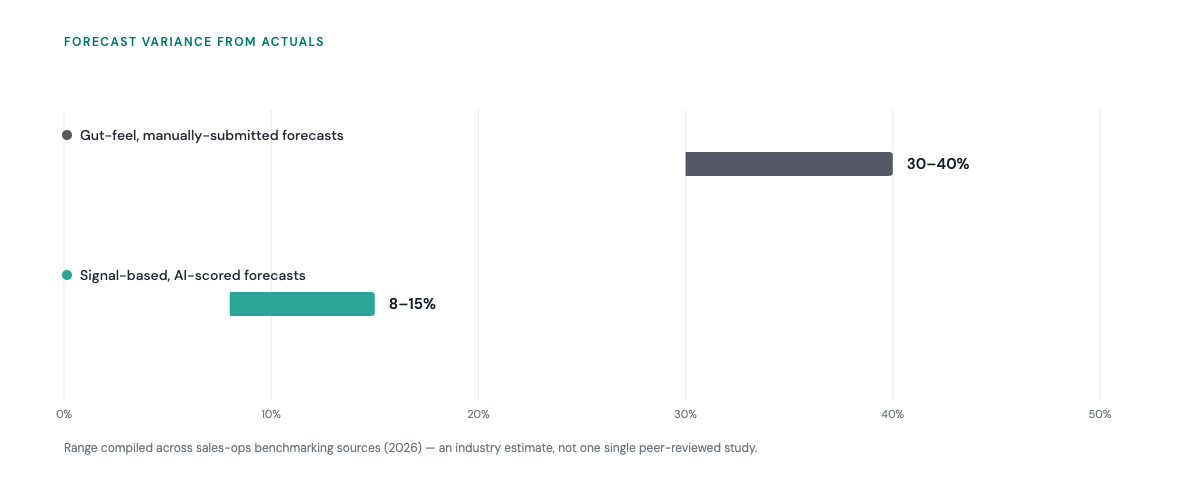
None of this is hypothetical. In a 2020 Gartner survey, fewer than half of sales leaders and sellers said they had high confidence in their organization's forecasting accuracy. That's not a stat about a badly run sales team. It's the median. Benchmarking compiled across sales-ops research since then generally puts manually submitted, gut-feel forecasts in the range of 30 to 40 percent variance from actual results, against roughly 8 to 15 percent for forecasts built from signal-based or AI-derived scoring. Treat those specific figures as an industry-compiled estimate rather than a single peer-reviewed study, but the direction holds across every source we checked: forecasts built from evidence beat forecasts built from feeling, and the gap isn't small.
What Signals Actually Go Into a Deal Health Score?
A deal health score is only as good as the signals feeding it, and the useful ones map closely to what MEDDPICC already asks a rep to qualify by hand:
| Signal | What it actually measures |
|---|---|
| Economic buyer engagement | Has the person with real budget authority spoken on a call, or is the rep still routed through a champion? |
| Champion behavior | Is the internal advocate actively selling the deal, looping in stakeholders and pushing on timeline, or just answering emails? |
| Competitive mentions | Has a named competitor, or "no decision," come up recently, and how? |
| Timeline drift | Has the expected close date moved, and how many times? |
| Decision-process clarity | Can anyone on the call actually describe the approval steps between now and a signature? |
| Talk/listen ratio | Is the rep pitching at a buyer who's gone quiet, or running an actual conversation? |
None of this is a new idea. It's the same criteria a good sales manager has always coached reps to track by hand. The difference is that a score built from call transcripts and account activity catches drift in real time, deal by deal, instead of once a quarter when a manager finally sits in on a call.
Why Can't a Manually-Entered CRM Stage Do This?
Because a manually entered field only reflects what a rep chose to type in, after the call ended, when they remembered to update it. Proponent's own analysis of customer CRMs found the average CRM record is only 35% complete. That's not an external research figure. It's what we've seen looking at our own customers' data, so treat it as an observation about the accounts we work with rather than a universal industry statistic. The mechanism behind it isn't specific to us, though: a field a human has to remember to fill in, after the fact, with no evidence attached, degrades every quarter a team runs on it. A deal health score built from the call itself doesn't have that failure mode, because there's no step where a rep has to remember to log it.
How Is a Deal Health Score Actually Built?
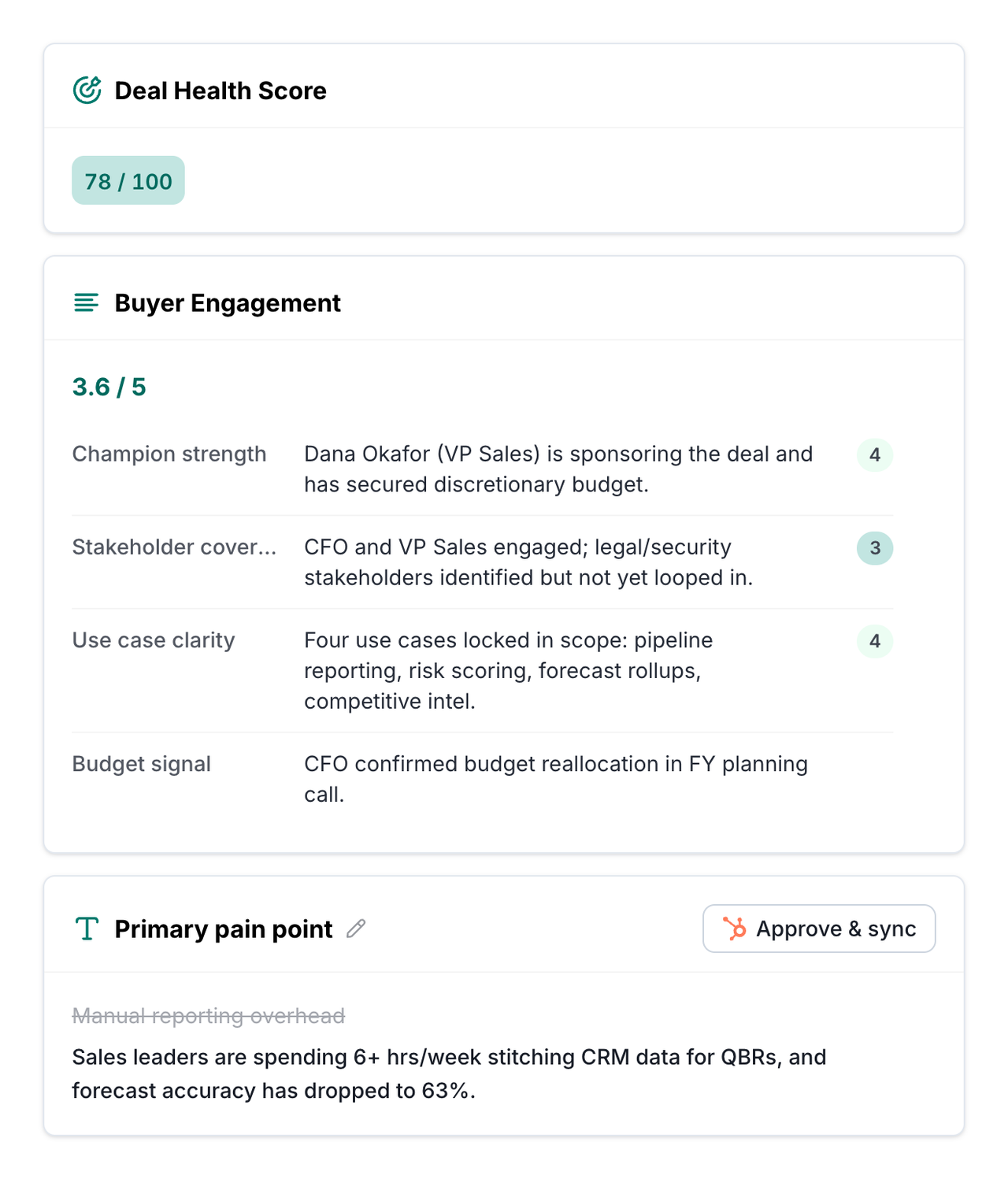
The honest version: a good deal health score is built by scoring the call and account activity directly, not by asking the rep to summarize it afterward. That means analyzing the transcript for the signals above, who spoke, what was said about the timeline, whether a competitor's name came up, combining that with CRM and email activity, and producing a score that updates as new calls happen rather than sitting frozen at whatever a rep last typed. (For a look at how this plays out against a specific competitor's approach, see our Gong vs Proponent comparison.)
This is also why a deal health score should come with the evidence behind it, not just a number. A score with no explanation is just a fancier gut feel. A score that says Economic Buyer engagement dropped because no one from the champion's leadership has been on a call in three weeks gives a manager something to act on, not just something to distrust.
If you want to see what a deal health score built from your own calls looks like, book a demo.
Frequently asked questions
Is AI deal scoring the same as lead scoring?
No. Lead scoring predicts whether a prospect is worth pursuing, usually before a rep has had a real conversation with them. Deal scoring evaluates an active, in-progress deal, based on what's happened in it so far.
Does AI deal scoring replace a rep's judgment?
No, it's meant to check it. A rep who's close to a deal can read tone and relationship dynamics a score doesn't capture. A score can catch what a rep's optimism might miss, like a champion who's gone quiet or a timeline that's slipped twice without anyone flagging it.
How is a deal health score different from a CRM's default win-probability field?
Most CRM win-probability fields are just a percentage tied to pipeline stage, for example "Proposal" defaulting to 60%. That's a stage average, not a score of this specific deal. An AI deal health score is derived from the actual behavior and conversations in that deal.
What data does AI deal scoring actually need?
At minimum, call recordings or transcripts and basic CRM and account data. The more of a deal's real conversations the system can see, the fewer gaps it has to guess across.
Can a deal health score be gamed the way a manually-entered stage can?
It's harder to game, because the inputs are things that were actually said or actually happened, not a field a rep typed in. A rep can't sandbag a deal health score the way they can sandbag their own stage assessment, since the score isn't asking the rep for an opinion.