Klue vs Proponent: Which One Fits Your Competitive Intelligence Program?
Klue curates public competitor signals into battlecards. Proponent builds competitive intelligence from what buyers actually say on your own sales calls. Here's how they compare.
 Prashant MohiteCo-founder & CEO6 min read
Klue is the category leader in competitive enablement: it pulls public signals about your competitors from the web and turns them into battlecards your reps can use in a deal. Proponent does something adjacent but different: it listens to your own sales calls and builds competitive intelligence from what buyers actually say, unprompted, about the competitors they're evaluating you against.
Both feed the same battlecard, but they start from opposite ends of the problem. Klue tells you what your competitor says about itself. Proponent tells you what your buyer believes about it, which is usually the more useful of the two.
Why Teams Compare Klue and Proponent
Klue and Proponent get compared because they sit in the same budget line: competitive intelligence and win/loss. But they're built around different questions. Klue asks what is happening across the competitive landscape right now, and how to get that in front of reps before a deal is lost to it. Proponent asks what this specific buyer already told you about that competitor, on a call you already recorded.
Most teams evaluating both aren't really choosing between two versions of the same tool. They're deciding which input their program is missing more.
What Klue Does Well
Klue is the default choice for structured competitive-enablement programs. It aggregates competitor data from dozens of external sources automatically, generates AI-drafted battlecard content, and lets teams build separate battlecards for sales, product, and executive audiences from the same competitor profile. Its Salesforce integration surfaces the right battlecard inside the deal record itself, and its 2025 Compete Agent pushes real-time competitive alerts directly into a rep's workflow.
Klue also runs a formal win/loss module. Win-Loss Cards pull deal notes out of Salesforce and attach them to a competitor's profile, and its Impact Analysis Report ties battlecard usage back to win rate, cycle length, and deal size. It's rated 4.8 out of 5 on G2, the highest of the dedicated competitive-intelligence platforms, and it's raised $62M from investors including Salesforce Ventures and Tiger Global.
Where Klue's Model Runs Into Limits
Klue's core input is external signal: competitor websites, review sites, job postings, and press, plus whatever a rep manually logs after a call. That's genuinely useful for tracking what a competitor is doing. It's a poor substitute for knowing what your own buyer actually thinks.
A battlecard built entirely from public research answers the objections marketing assumes a buyer will raise. It doesn't answer the ones a buyer actually raised on your last three calls with a similar account, because nobody is systematically listening to those calls for competitive signal. Klue depends on a rep remembering to log a competitive mention after the fact, the same gap that makes most CRM data unreliable for win/loss analysis in the first place.
Reviewers echo the same pattern: Klue's integrations work well with major CRMs but thin out elsewhere, alert volume needs manual tuning to stay useful, and price is a real barrier below the enterprise tier. It doesn't publish pricing and sells annual contracts only, with separate rates for the people who curate content and the people who just consume it.
What Proponent Does Differently
Proponent reads every sales call and extracts competitive intelligence directly from what buyers say, without waiting for a rep to write it down.
- Competitor mentions, captured automatically. Every time a buyer names a competitor, compares pricing, or explains why a previous tool failed them, it's logged and tied to that specific deal, not paraphrased from memory after the call.
- Built from buyer language, not competitor marketing. Battlecard content built this way answers what the buyer actually believes about a competitor, which is frequently different from what that competitor's own website claims.
- Tied to deal outcomes automatically. Every mention connects to whether the deal was won or lost, so patterns like a specific competitor showing up disproportionately in losses surface without a manual win/loss interview program.
- No separate curator tier. Every seat, sales, PMM, ops, leadership, sees the same intelligence, priced by call volume rather than by how many people are allowed to edit a battlecard.
Klue vs Proponent, Side by Side
| Klue | Proponent | |
|---|---|---|
| Primary input | Public competitor signals plus manually logged notes | What buyers say, automatically, on recorded calls |
| Battlecard authoring | Curated by a dedicated "curator" role | Built from extracted call data, no manual curation required |
| Win/loss signal | Requires a Win-Loss Card logged per deal | Captured automatically from every call, tied to outcome |
| Pricing model | Custom quote, separate curator and consumer seat tiers | Flat, by call volume, unlimited seats |
| Best fit | Formal, dedicated competitive-enablement programs | Teams that want competitive intel without a dedicated CI hire |
What This Actually Costs
Klue doesn't publish pricing, but industry pricing trackers put its entry-level tier at roughly $16,000 a year for a small team just formalizing a competitive intelligence practice, climbing to $25,000 to $50,000 for a mid-size program and $50,000 to $100,000 or more at enterprise scale, before accounting for the premium Klue charges for curator seats over consumer seats.
Proponent's Scale tier, built for a similarly sized revenue team, is $999 a month, about $12,000 a year, with every seat included at no extra cost regardless of role.
Pricing figures above are accurate as of July 2026 and may change — confirm current rates directly with Klue and Proponent before purchasing.
That's not really an apples-to-apples swap, since Klue also monitors your competitors' public moves and Proponent doesn't. But if the reason you were evaluating Klue was to get competitive intelligence in front of reps without hiring someone to run a curation program, the cost gap is hard to ignore.
Which One Should You Choose
Choose Klue if your team is ready to run a dedicated competitive-enablement program: someone owns curation, you want a formal win/loss workflow layered on top of CRM data, and you're tracking competitors' public moves as much as what your own buyers say about them.
Choose Proponent if what you actually need is to know what your buyers believe about the competitors they mention, drawn directly from your own sales calls, without adding a curator role or an extra line item for the people who just need to read a battlecard.
For more on why buyer-conversation data outperforms CRM fields and post-mortem interviews for this exact problem, see our guide to win-loss analysis and competitive intelligence. If you're building your first set of battlecards from scratch, How to Build Competitive Battlecards in 7 Steps walks through the process end to end.
See what your own calls already reveal about the competitors you're up against: Proponent runs a two-week pilot connected to your existing CRM and call recorder, with no long-term contract, before you decide anything.
Frequently asked questions
Can Klue and Proponent be used together?
Yes. They pull from different inputs, so some teams run Klue for public competitor tracking and formal battlecard authoring while feeding it insights from Proponent's call analysis, rather than treating them as an either or choice.
Does Proponent build battlecards the way Klue does?
Not in the same format. Proponent surfaces the raw competitive intelligence, what buyers say, how often, and tied to which outcome, rather than providing Klue's dedicated battlecard editor and multi-audience card layouts.
Why doesn't Klue publish its pricing?
Like most enterprise software sold on annual contracts, Klue's price depends on team size and the ratio of curator to consumer seats, so it quotes deals individually rather than publishing a rate card.
Is Proponent only useful for competitive intelligence?
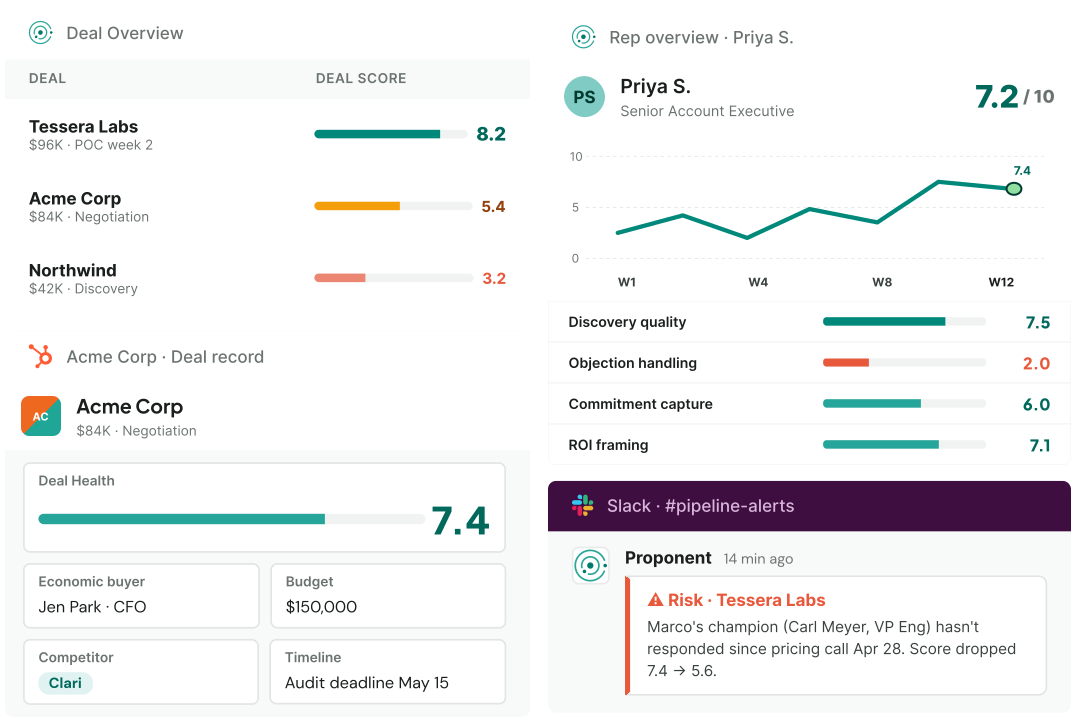
No. Competitive intelligence is one output of a broader practice. Proponent also scores deal health, coaches reps, and updates the CRM from the same calls it analyzes for competitor mentions.
How fast can I see what my buyers are already saying about competitors?
Proponent's two-week pilot connects to your existing recorder and CRM in about 15 minutes and surfaces competitor mentions from that point forward, with no curation setup required.